Source Dossier — F1-P4
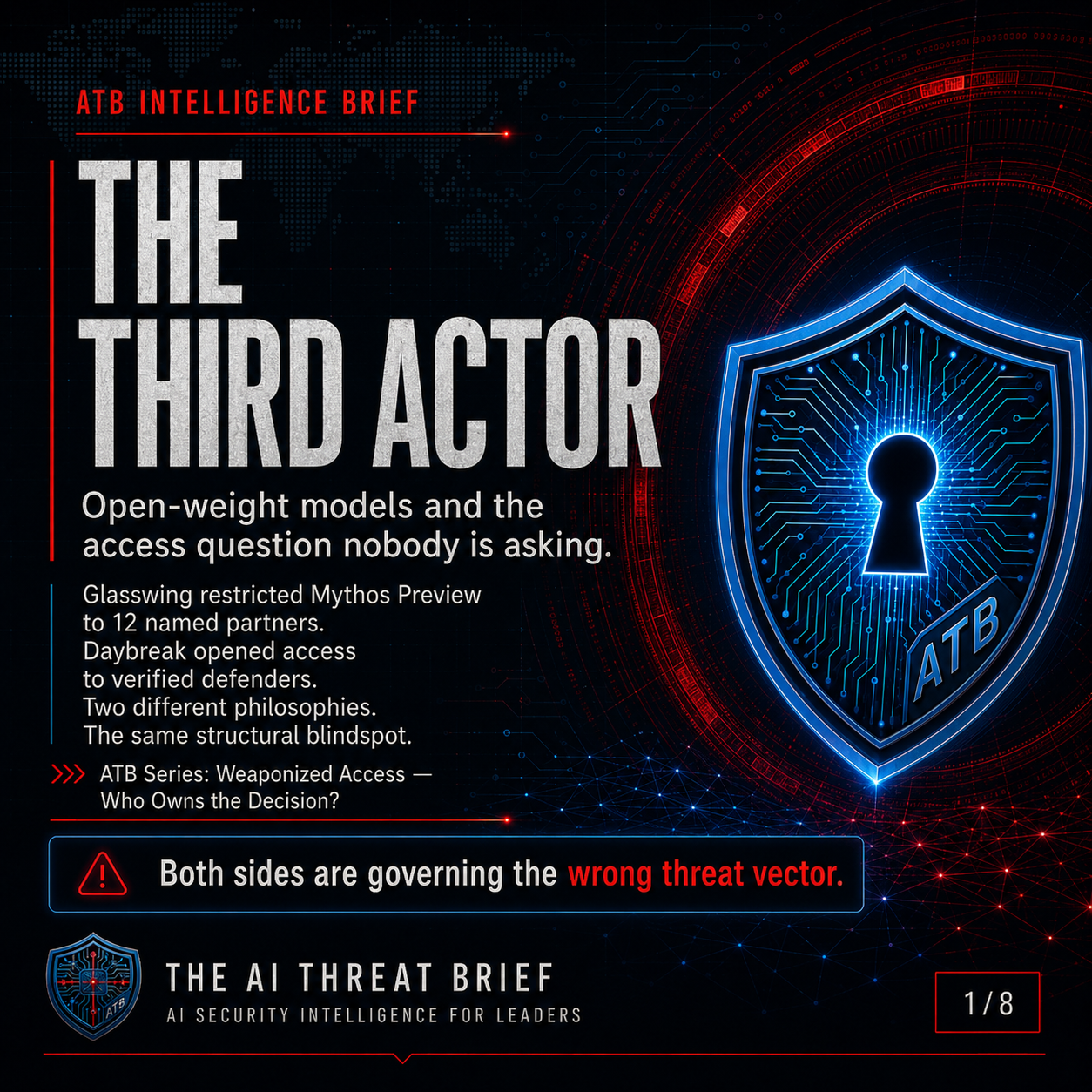
The Third Actor: Open-Weight Models and the Access Question Nobody Is Asking
ATB publishes a full source dossier for every Intelligence Brief. Every source used in this analysis is listed below with its tier classification, any editorial disclosure that applies, and a brief note on why this source was included.
Source Tier Definitions: Primary — original reporting, official documents, peer-reviewed research, direct vendor disclosures. Secondary — credible analysis citing primary sources, established trade press with editorial standards. All sources independently verified for this post.
Primary Sources — Independent Research
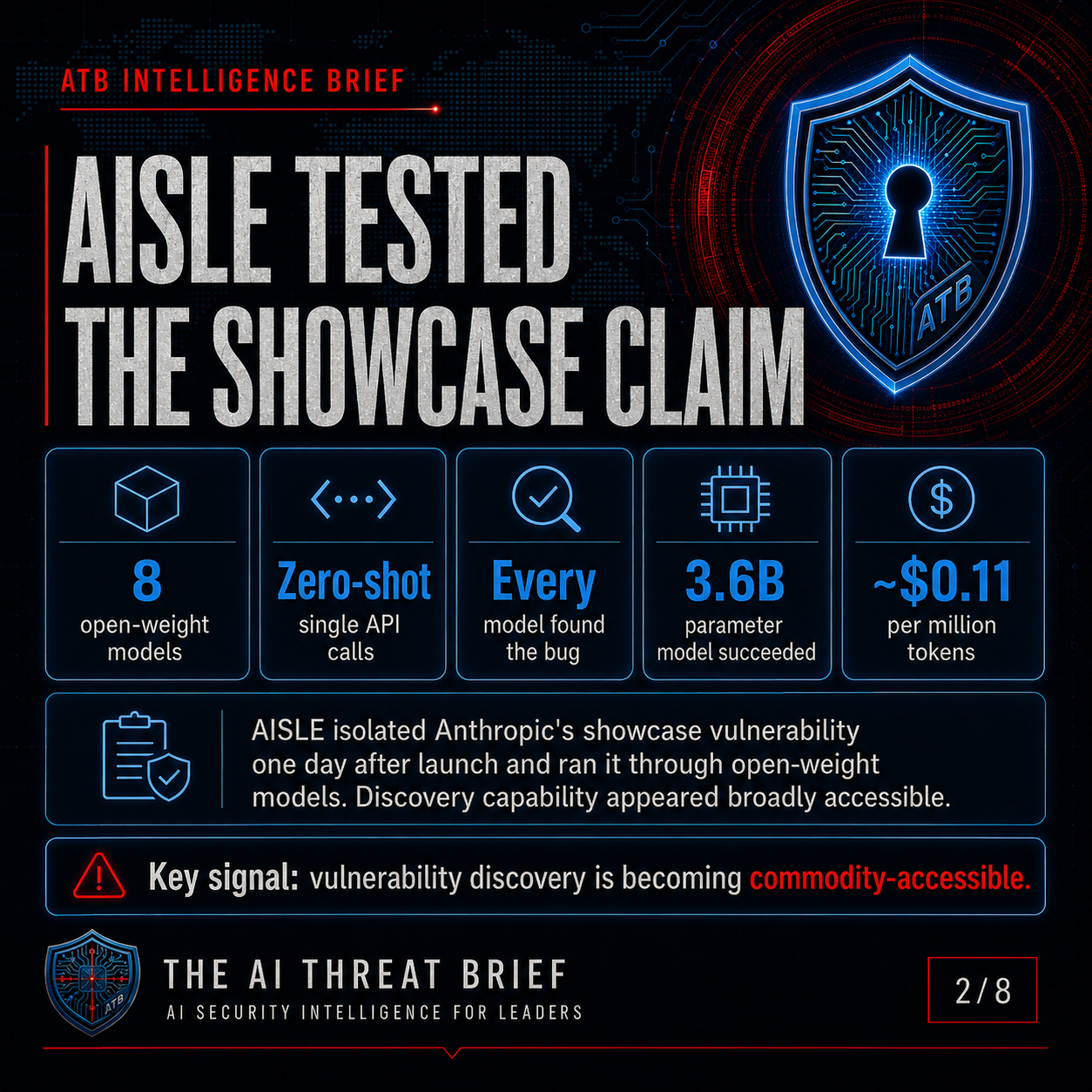
1. AISLE — AI Cybersecurity After Mythos: The Jagged Frontier
Author: Stanislav Fort, AISLE | Published: April 7, 2026 | Tier: Primary
Editorial Disclosure: AISLE holds an explicitly contrarian position on Glasswing: Fort argues the capability framing overstates the exclusivity of Mythos. Fort has prior research affiliations with Anthropic and Google DeepMind.
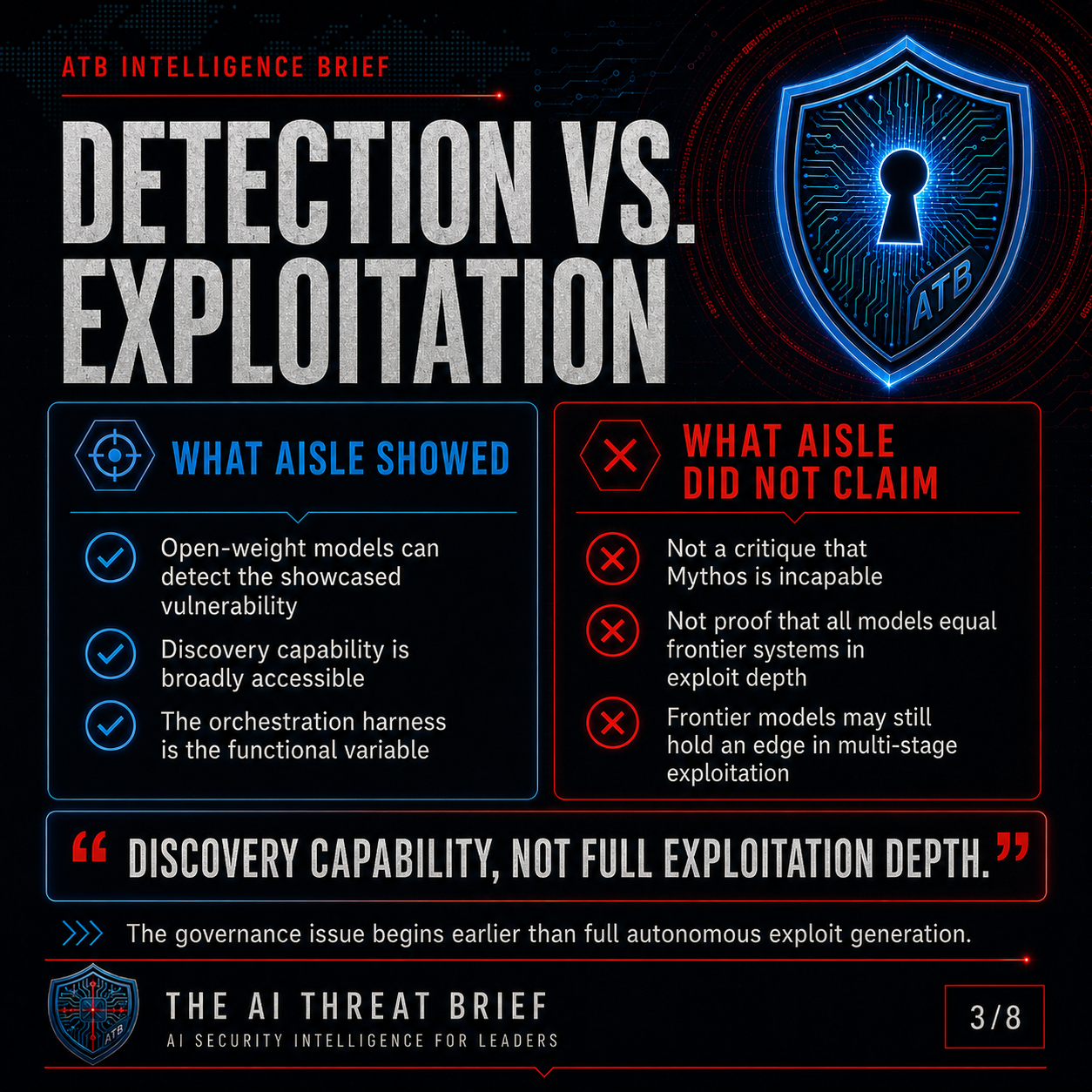
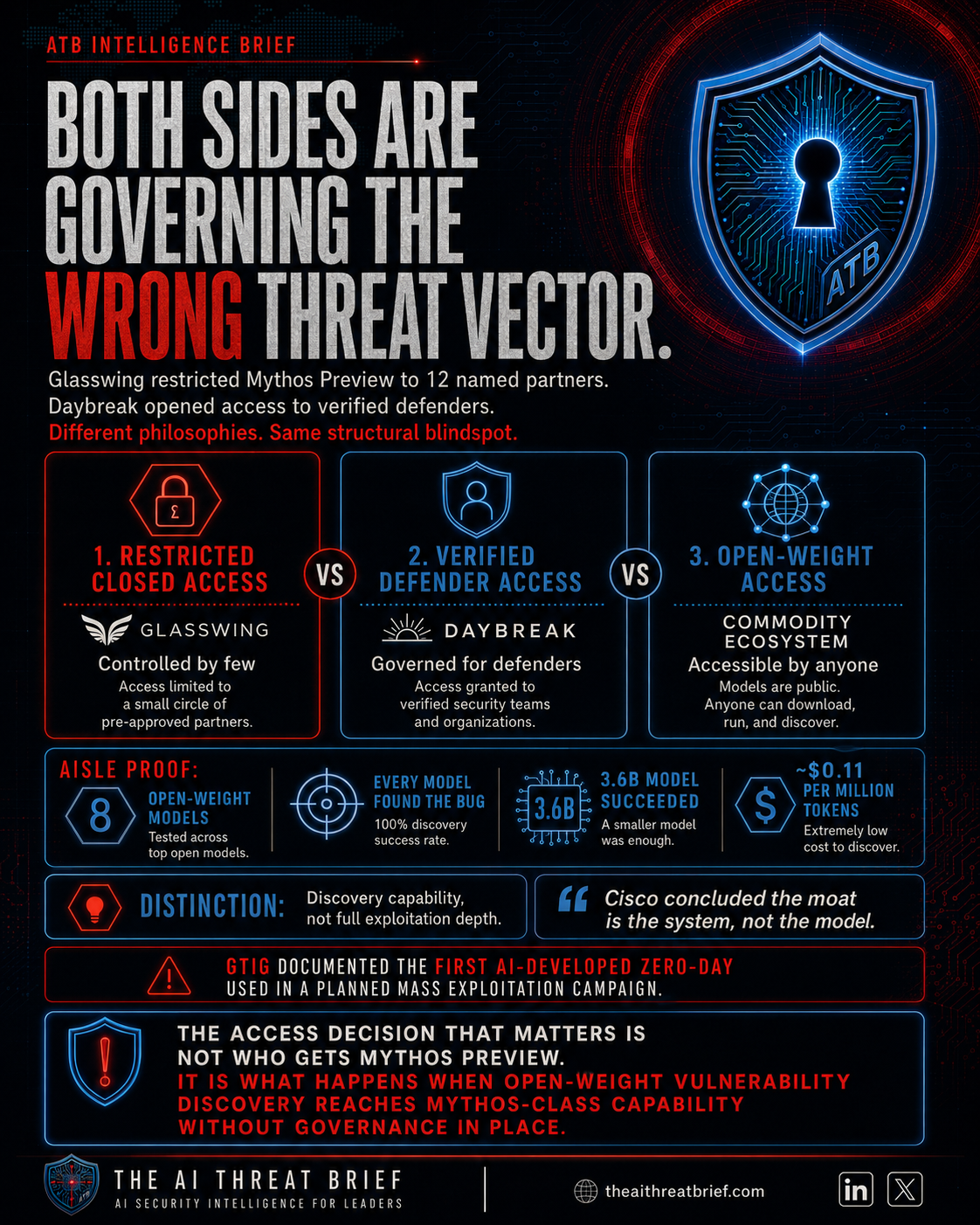
8 of 8 open-weight models detected CVE-2026-4747 in zero-shot single API calls with no scaffolding. AISLE explicitly distinguishes detection capability (broadly accessible) from exploitation depth (potentially more frontier-dependent) — a distinction ATB preserves throughout the post.
aisle.com/blog/ai-cybersecurity-after-mythos-the-jagged-frontier
2. AISLE — System Over Model: Zero-Day Discovery at the Jagged Frontier
Author: Stanislav Fort, AISLE | Published: April 14, 2026 | Tier: Primary
Editorial Disclosure: Same as Source 1.
Technical companion to Source 1. Introduces the nano-analyzer pipeline — one Python file, no agentic loop, sub-$100 total cost. Key finding: “No single model is best on everything. Each has different blind spots, which is exactly the argument for many eyes, not one powerful eye.”
aisle.com/blog/system-over-model-zero-day-discovery-at-the-jagged-frontier
3. AISLE GitHub — Mythos Jagged Frontier Repository
Published: April 7, 2026 | Tier: Primary
Editorial Disclosure: Same as Source 1.
Full transcripts of all 8-of-8 model tests published publicly. Anyone can re-run the same prompts. The public availability of the reproducible methodology is itself analytically relevant — the evidentiary basis for the post’s argument is not restricted to Glasswing partners.
github.com/stanislavfort/mythos-jagged-frontier
4. AISLE — AISLE Discovers 20 OpenSSL Zero-Days in 6 Months
Published: April 24, 2026 | Tier: Primary
Editorial Disclosure: Same as Source 1.
CVE-2026-28386 was independently discovered by both AISLE and Anthropic — AISLE first, Anthropic 63 days later. On FreeBSD (Anthropic’s own showcase codebase), the comparative tally is Anthropic 3 CVEs, AISLE 3 CVEs. This is the competitive scoreboard context the post references.
aisle.com/blog/aisle-discovers-20-openssl-zero-days-in-6-months
5. CETaS / Alan Turing Institute — Claude Mythos: What Does Anthropic’s New Model Mean for the Future of Cybersecurity?
Authors: Chris Hicks, Connor Attridge, Ardi Janjeva, Carolyn Ashurst | Published: April 2026 | Tier: Primary
The authoritative independent institutional voice on Glasswing governance implications. ATB’s primary independent governance framework anchor for this series — no commercial stake in Glasswing or Daybreak outcomes.
cetas.turing.ac.uk/publications/claude-mythos-future-cybersecurity
6. International AI Safety Report 2026
Published: February 2026 | Tier: Primary
Published before Glasswing launched. Provides the foundational governance gap characterization that predates the access debate this post analyzes. Key: “Open-weight models’ safeguards are easier to remove, enabling potential malicious use.”
arxiv.org/pdf/2602.21012
7. arXiv — Mitigating Cyber Risk in the Age of Open-Weight LLMs: Policy Gaps and Technical Realities
Published: 2025–2026 | Tier: Primary
Policy-focused technical analysis confirming the open-weight governance gap is a named research area. MITRE OCCULT data: DeepSeek-R1 achieving over 90% accuracy on offensive cyber knowledge tests.
arxiv.org/pdf/2505.17109
8. CETaS — The Next Frontier: Security Implications of Future AI Paradigms
Authors: Ardi Janjeva, Sylvester Kaczmarek, Angus Shennan, Carolyn Ashurst | Published: April 30, 2026 | Tier: Primary
Maps 15 alternative AI research paradigms graded on usability, governability, and cost. The governability dimension provides the forward-looking policy framing for the structural governance gap this post identifies.
cetas.turing.ac.uk/publications/future-AI-paradigms
9. Niels Provos — Finding Zero-Days with Any Model
Published: April 29, 2026 | Tier: Primary
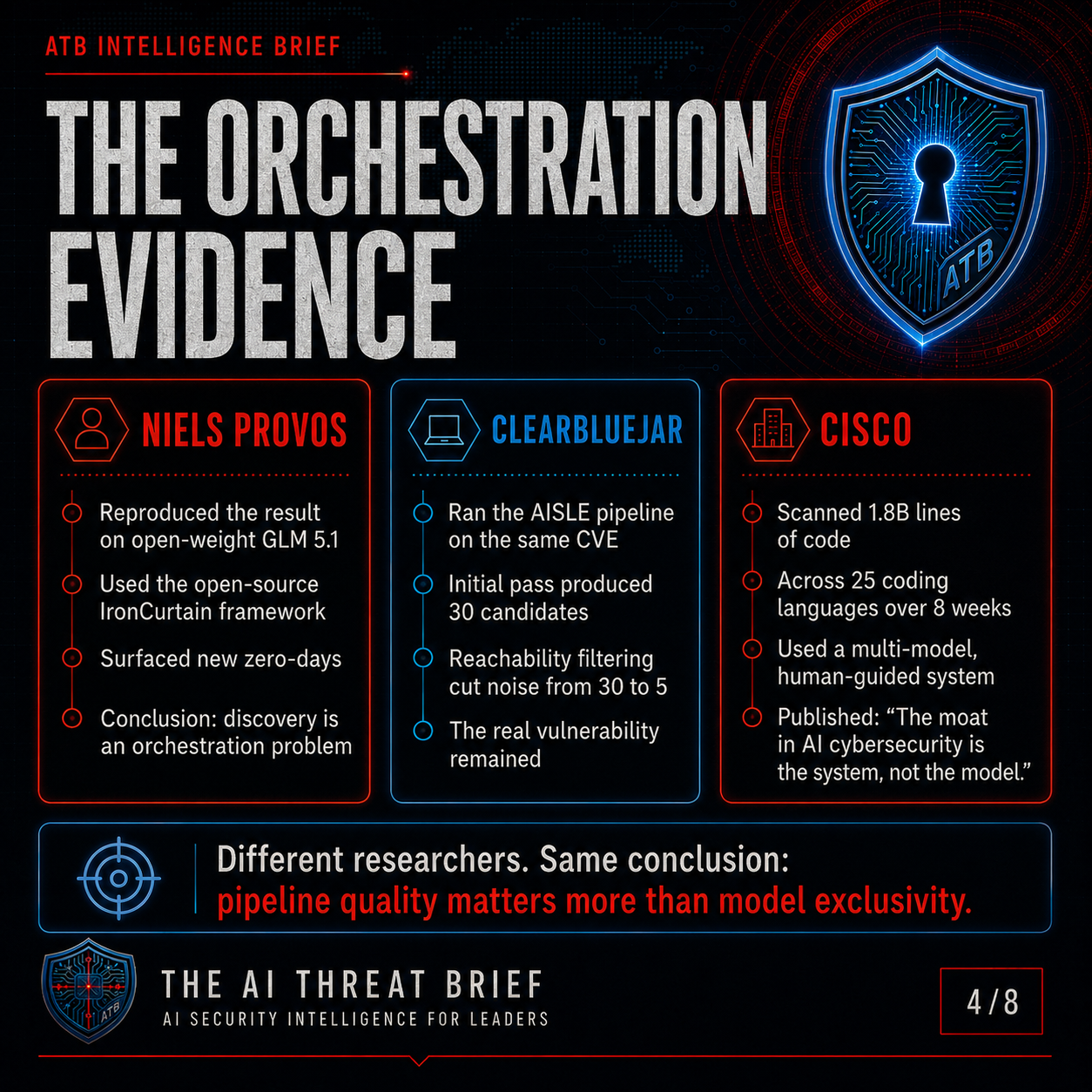
Provos is the original author of the 1998 BSD code underlying CVE-2026-4747 — no commercial stake in any AI lab. GLM 5.1 drove vulnerability discovery end-to-end via Z.AI’s API. New zero-days surfaced beyond the CVE-2026-4747 showcase. Key finding: “Vulnerability discovery is an orchestration problem, not a frontier-model problem.” Note: fully local inference was not demonstrated — the access bar is API credits, not consumer hardware.
provos.org/p/finding-zero-days-with-any-model
10. Niels Provos — The Case For Open-Weight Models and Why We Can’t Trust Frontier Labs
Published: June 2026 | Tier: Primary
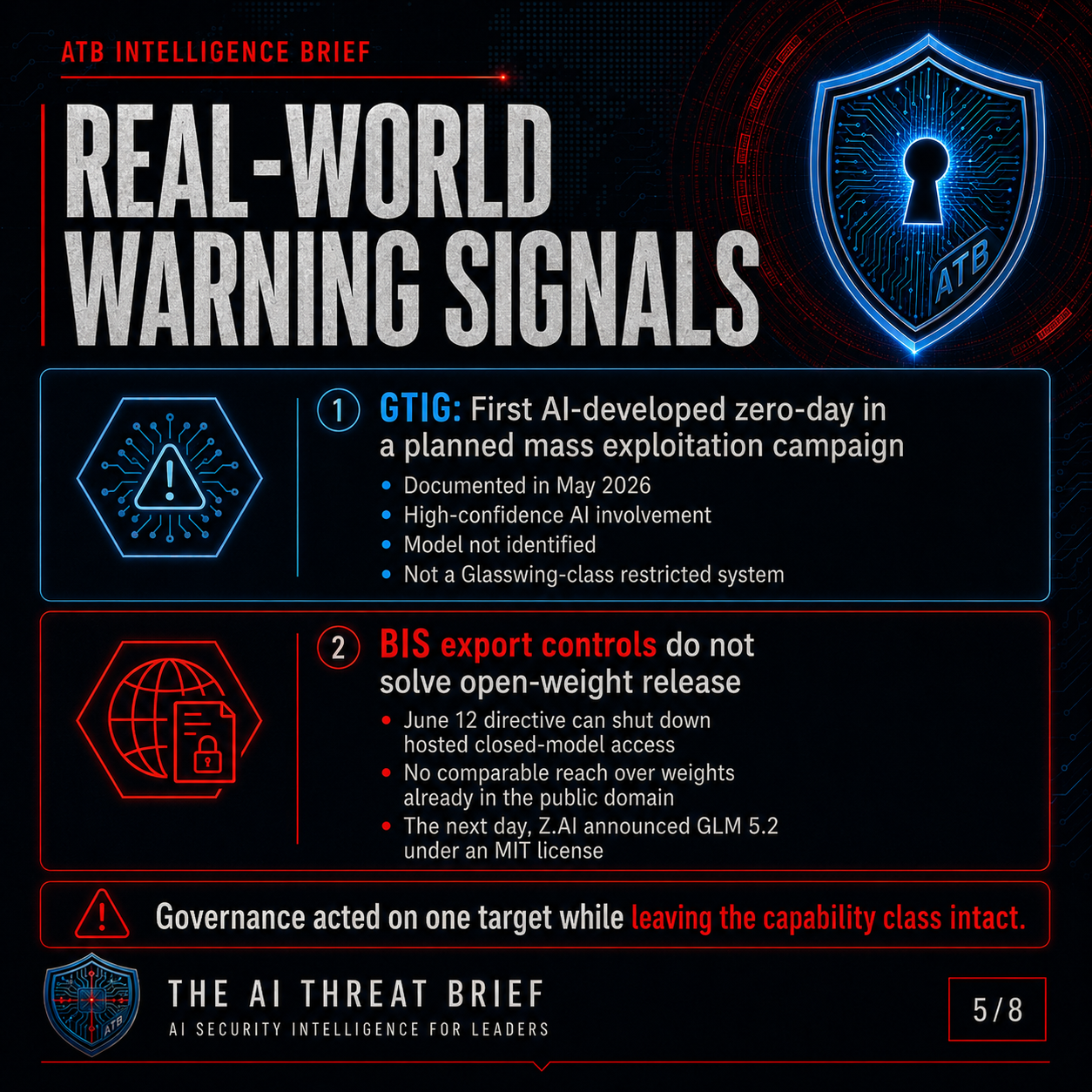
Contains the geopolitical signal this post’s analysis uses: Z.AI announced GLM 5.2 on June 13, one day after the BIS directive, with MIT-licensed open weights framed explicitly as a response to tightening US export controls.
provos.org/p/case-for-open-weight-models
11. clearbluejar — System Over Model, Tested
Published: June 4, 2026 | Tier: Primary
Independent security researcher with no disclosed AI lab affiliation. Both open-weight models found CVE-2026-4747 with one system engineering step (reachability filter). Key finding: “The problem was variance, not capability.” Also surfaced a new defect not in the AISLE showcase set.
clearbluejar.github.io/posts/system-over-model-tested-mythos-freebsd-local-openweight
Primary Sources — Corporate
12. Google DeepMind — Building Secure AGI: Evaluating Emerging Cyber Security Capabilities of Advanced AI
Published: March 3, 2026 | Tier: Primary
Editorial Disclosure: Google is a Glasswing partner and Anthropic investor. The framework paper serves Google’s interest in establishing an evaluation posture distinct from restriction programs.
Most comprehensive AI offensive cyber capability evaluation framework to date. Analyzed over 12,000 real-world AI-assisted attack attempts in 20 countries. Establishes a third governance posture (evaluation framework) distinct from both Glasswing and Daybreak.
deepmind.google/blog/evaluating-potential-cybersecurity-threats-of-advanced-ai
13. GTIG — Adversaries Leverage AI for Vulnerability Exploitation, Augmented Operations, and Initial Access
Published: May 11, 2026 | Tier: Primary
Editorial Disclosure: Google Threat Intelligence Group — Google-affiliated. GTIG findings are primary source material; analytical framing reflects Google’s position in the AI threat intelligence market.
Contains the first confirmed AI-developed zero-day deployed in a mass exploitation campaign. The model used was not identified as Gemini or any named frontier closed model — the governance gap that fired in a real exploitation campaign is precisely the gap Glasswing and Daybreak do not cover.
cloud.google.com/blog/topics/threat-intelligence/ai-vulnerability-exploitation-initial-access
14. GTIG — Distillation, Experimentation, and Integration of AI for Adversarial Use
Published: February 12, 2026 | Tier: Primary
Editorial Disclosure: Google Threat Intelligence Group — same as Source 13.
Establishes the baseline threat actor AI usage patterns the May 2026 report escalates. Documents how access restriction at the model level does not govern skill injection at the orchestration layer.
cloud.google.com/blog/topics/threat-intelligence/distillation-experimentation-integration-ai-adversarial-use
15. Cisco — 8 Years of Security Research in 8 Weeks
Published: June 2026 | Tier: Primary
Editorial Disclosure: Cisco is a named Glasswing launch partner. The multi-model harness finding runs counter to a strict interpretation of the model-restriction rationale of the programs Cisco participated in.
Cisco scanned 1.8 billion lines of code using a multi-model harness — not Mythos exclusively. Key finding: “The moat in AI cybersecurity is the system, not the model.” Published from inside the Glasswing program.
blogs.cisco.com/news/8-years-of-security-research-in-8-weeks
16. Cisco — A New Model for Infrastructure Security
Published: June 2026 | Tier: Primary
Editorial Disclosure: Cisco — same as Source 15.
Companion piece documenting Cisco’s four-pillar defense architecture. Confirms: “The bar hasn’t just moved. It’s been dropped.”
blogs.cisco.com/cisco-on-cisco/how-cisco-defends-against-ai-threats
17. Anthropic — Project Glasswing: An Initial Update
Published: May 22, 2026 | Tier: Primary
Editorial Disclosure: Anthropic developed Mythos Preview and operates Project Glasswing. All Glasswing quantitative claims originate here and are attributed explicitly.
The only primary source for Glasswing quantitative claims. As of May 22: more than 10,000 vulnerabilities found; 75 patched. This post does not dispute the numbers — it disputes that restricted access to the model that produced them is the appropriate governance response.
anthropic.com/research/glasswing-initial-update
Secondary Sources
18. Stanislav Fort — Mythos at Home, and It’s Called AISLE
Published: June 2026 | Tier: Secondary
Editorial Disclosure: Same as Source 1.
UC Berkeley Vulnerability Initiative scoreboard: AISLE ranks first globally in three of eight categories. On FreeBSD, Anthropic 3 CVEs, AISLE 3 CVEs on Anthropic’s own showcase codebase.
stanislavfort.substack.com/p/mythos-at-home-and-its-called-aisle
19–21. flyingpenguin (Three Sources)
Tier: Secondary
Editorial Disclosure: flyingpenguin holds a declared editorial position that Anthropic’s Glasswing claims are overstated. flyingpenguin is included here because it first indexed several findings later independently verified from primary sources. flyingpenguin is not the citation anchor for any specific claim in this post.
FreeBSD CVE-2026-4747 Log — flyingpenguin.com/freebsd-cve-2026-4747-log
The Boy That Cried Mythos — flyingpenguin.com/the-boy-that-cried-mythos
June 2026 Executive Summary — flyingpenguin.com/executive-summary-glasswing-june-2026
Governance and Legal Reference Sources
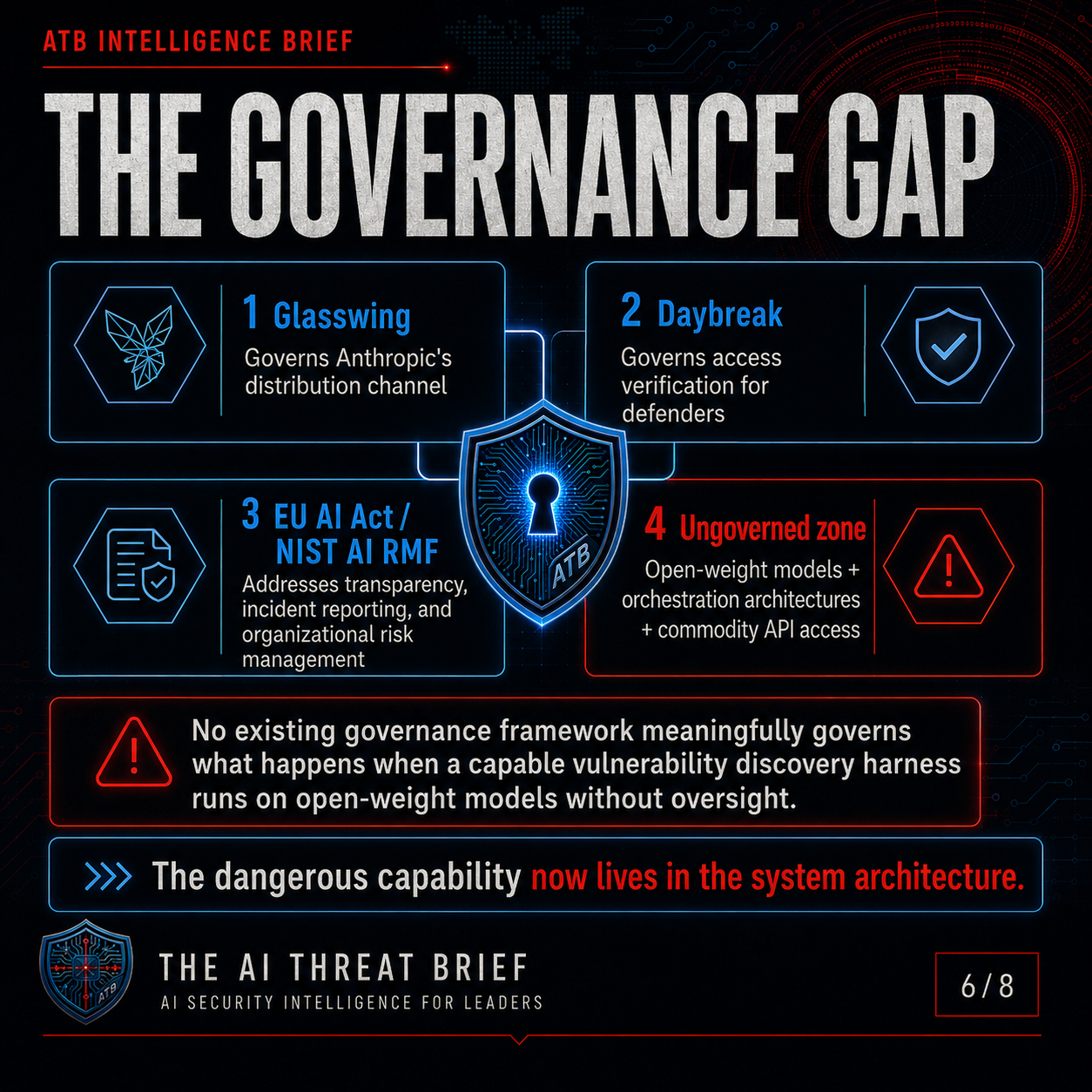
22. EU AI Act
Tier: Primary | Type: Official Document
The open-source carve-out excludes publicly released model weights from several GPAI obligations — cited to document the structural limitation of existing frameworks relative to the open-weight orchestration threat surface.
eur-lex.europa.eu — EU AI Act
23. NIST AI Risk Management Framework (AI RMF)
Tier: Primary | Type: Official Document
Cited as the organizational-level AI risk management framework not designed for open-source orchestration architectures operating on commodity API access.
airc.nist.gov/RMF
ATB Editorial Transparency
ATB publishes a full source dossier for every Intelligence Brief. Sources are tiered, editorial disclosures are applied to affiliated or position-holding sources, and the analytical weight given to each source is documented. The contrarian sources (AISLE, Provos, clearbluejar, flyingpenguin) provided the primary evidence base for this post’s argument. The corporate sources (GTIG, Cisco, Anthropic) provided corroboration and quantitative grounding. Independent sourcing outweighs corporate sourcing 12 to 7 at the primary tier.
ATB Source Dossier | F1-P4 — The Third Actor | Weaponized Access Series | theaithreatbrief.com | June 2026