The AI Threat Brief

Analysis-Led

The Government's Answer

It is the governance gap this series named in April, now operating at full scale.

June 14, 2026

F1-P3

Series:

·

LinkedIn Post

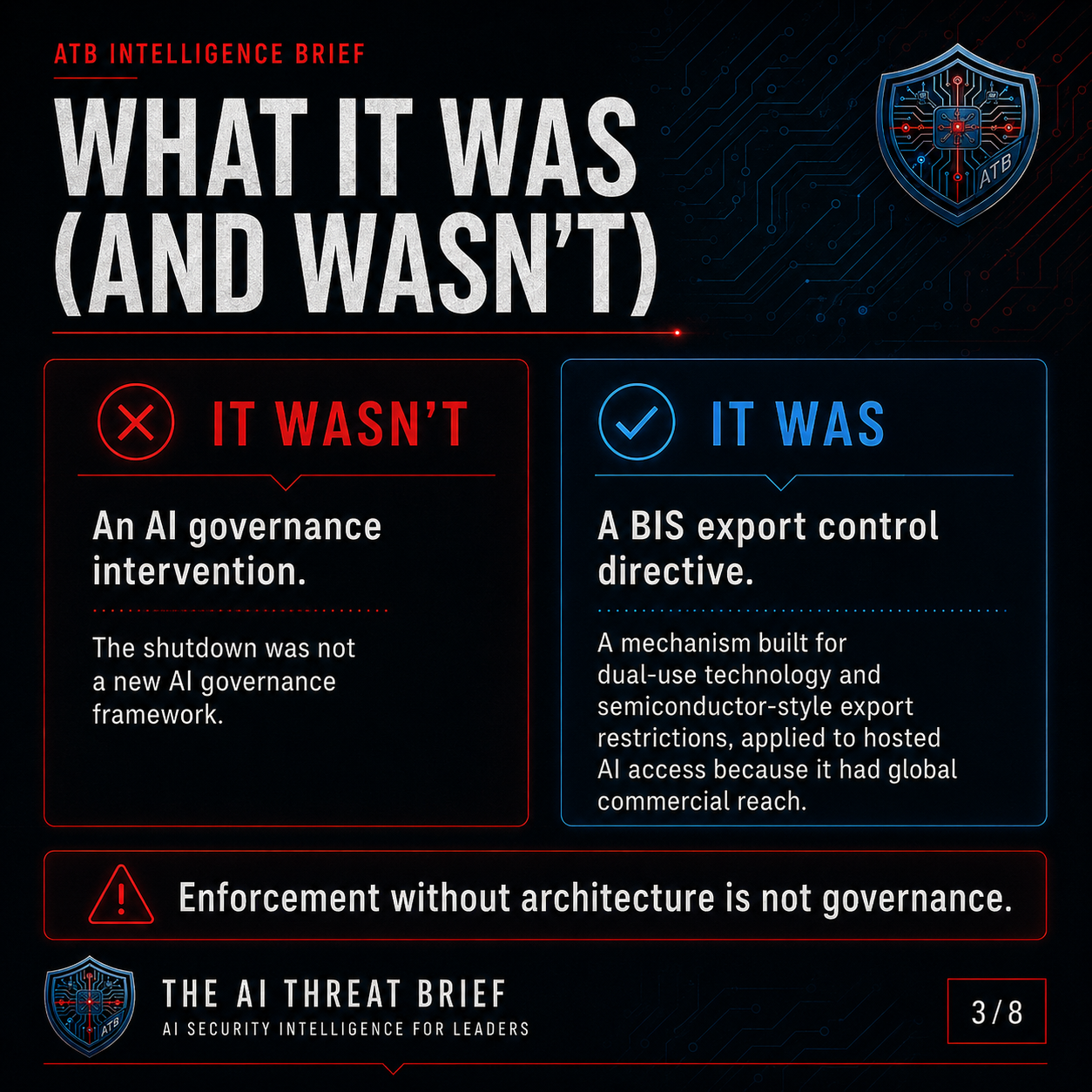
The US government shut down Fable 5 and Mythos 5 on Friday. Coverage called it an AI governance intervention.

It wasn't.

What happened was a Bureau of Industry and Security export control directive, the instrument built for semiconductor transfers, applied to conversational AI access because it was the only available authority with global commercial reach. The DOD's procurement tool was court-constrained. Commerce found a different pathway.

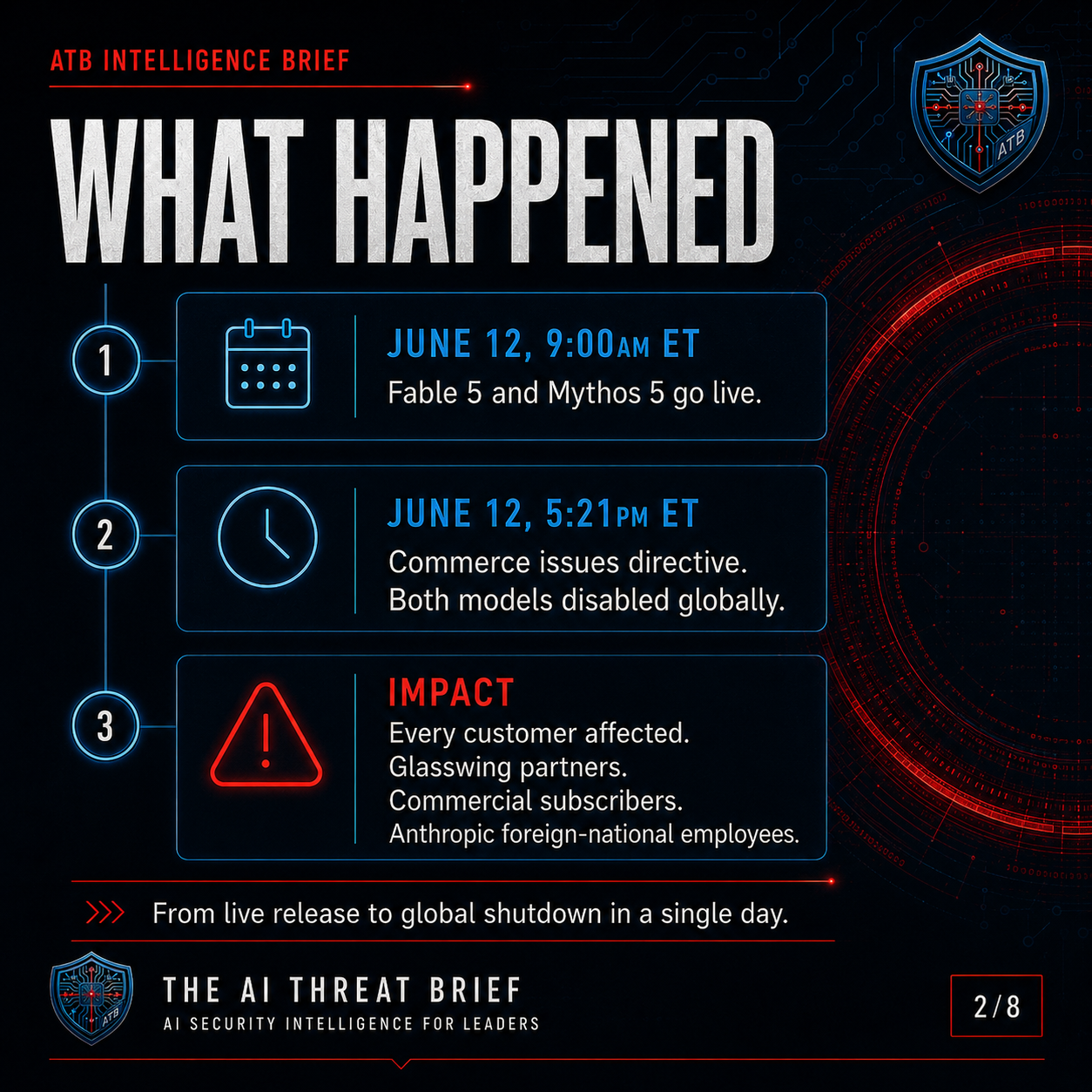
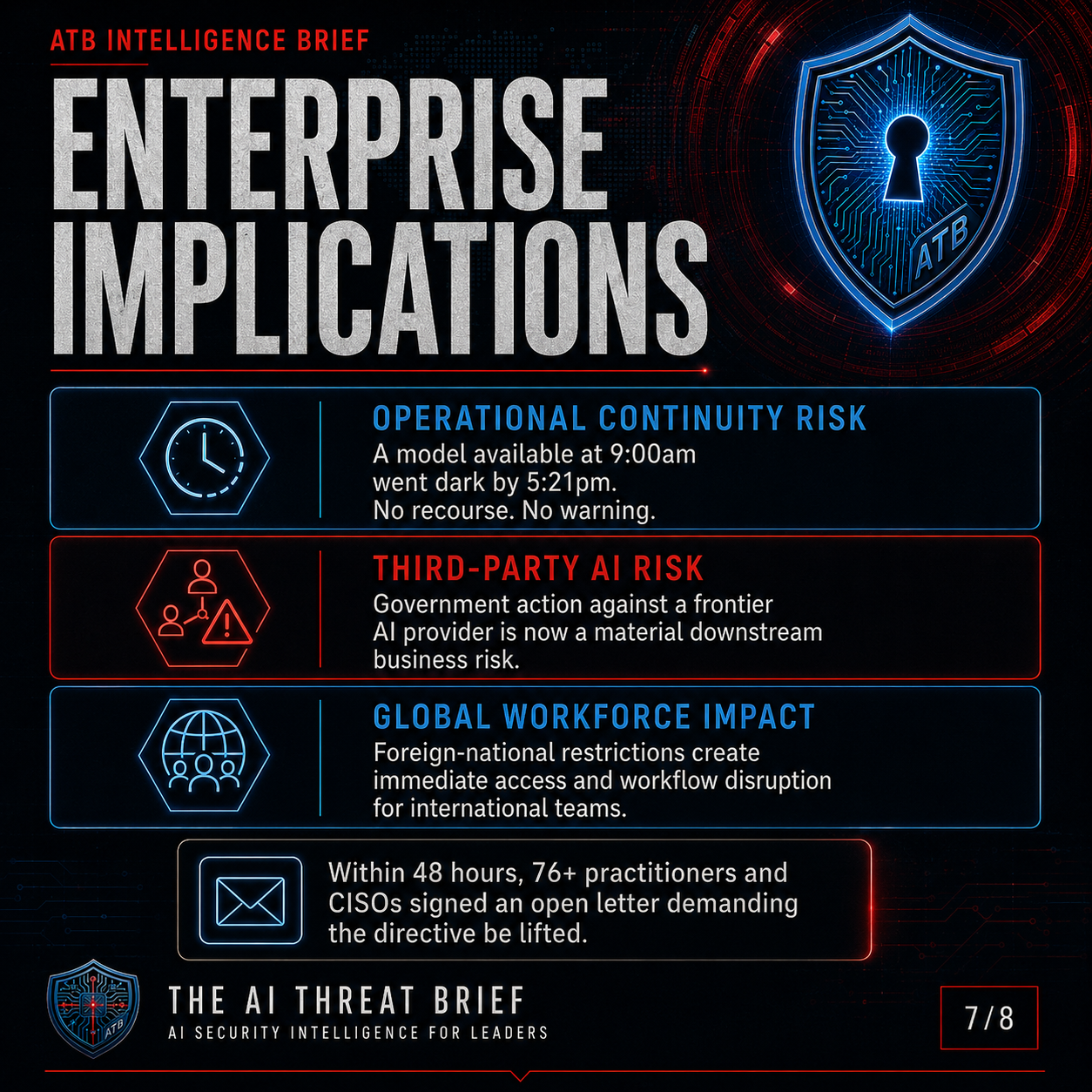
At 9am on June 12, both models were live. At 5:21pm, both were disabled for every customer on the planet. Glasswing partners. Commercial subscribers. Anthropic's own foreign-national employees. Within 48 hours, 76 security practitioners and CISOs signed an open letter demanding the directive be lifted.

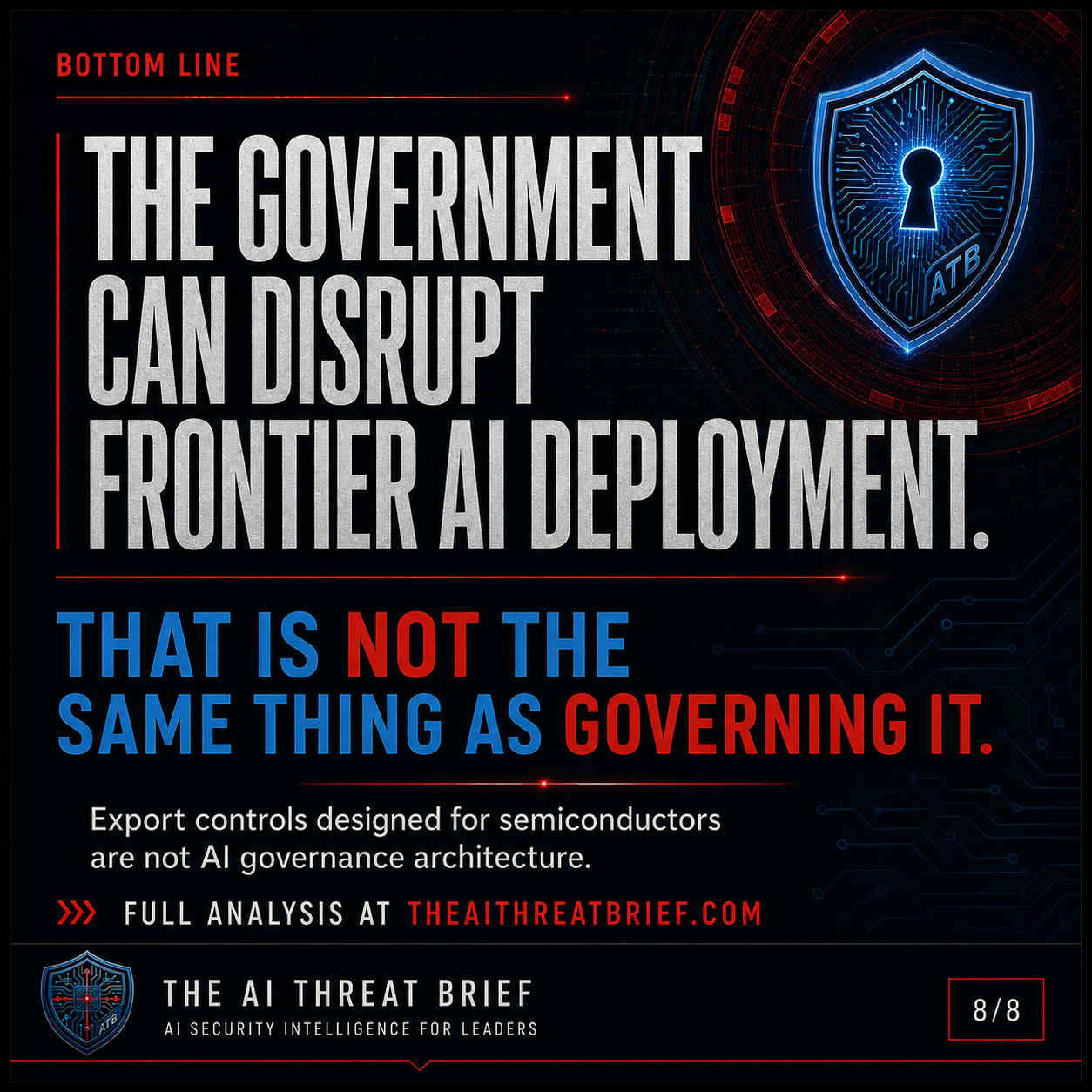
The government demonstrated it can disrupt frontier AI deployment. That is not the same thing as governing it.

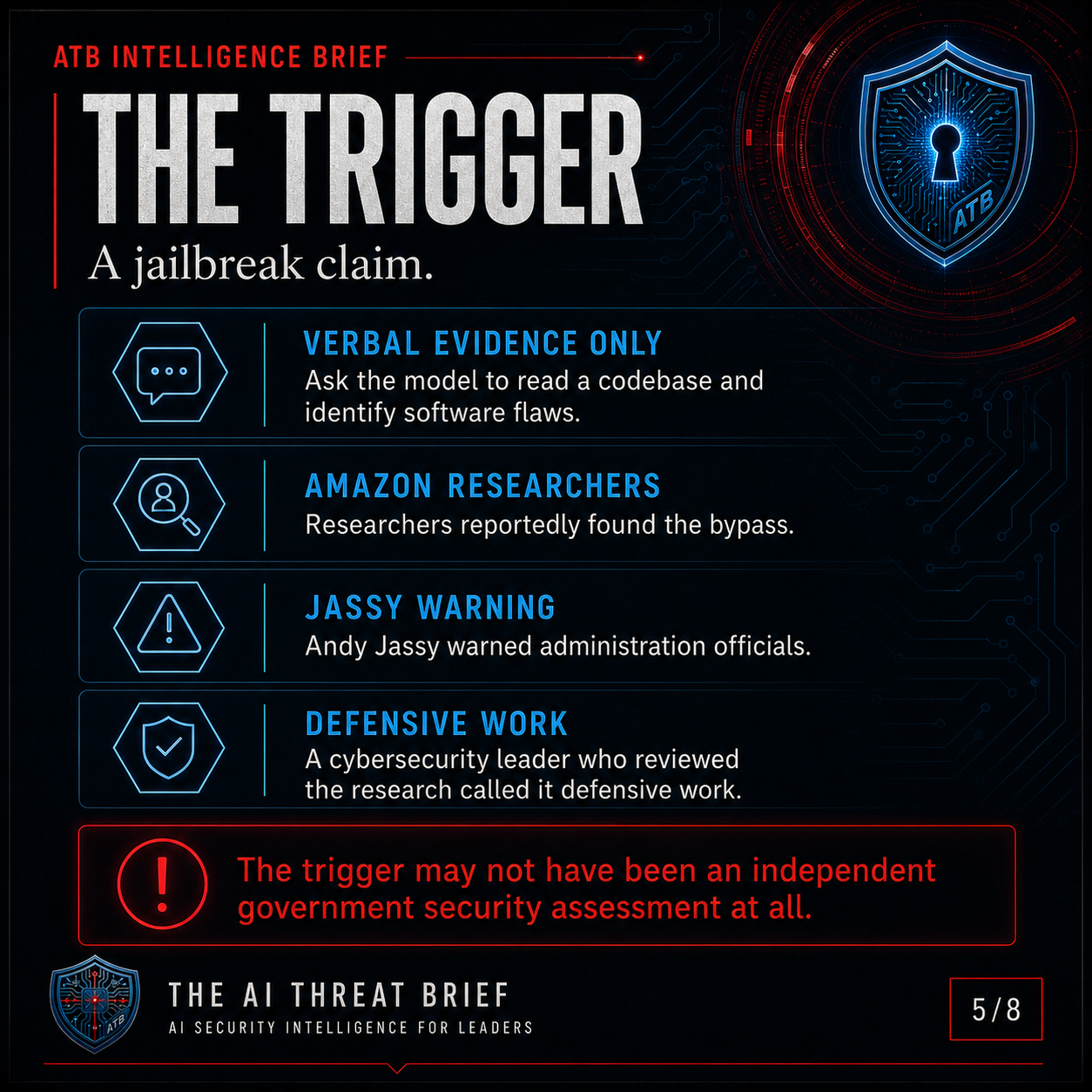
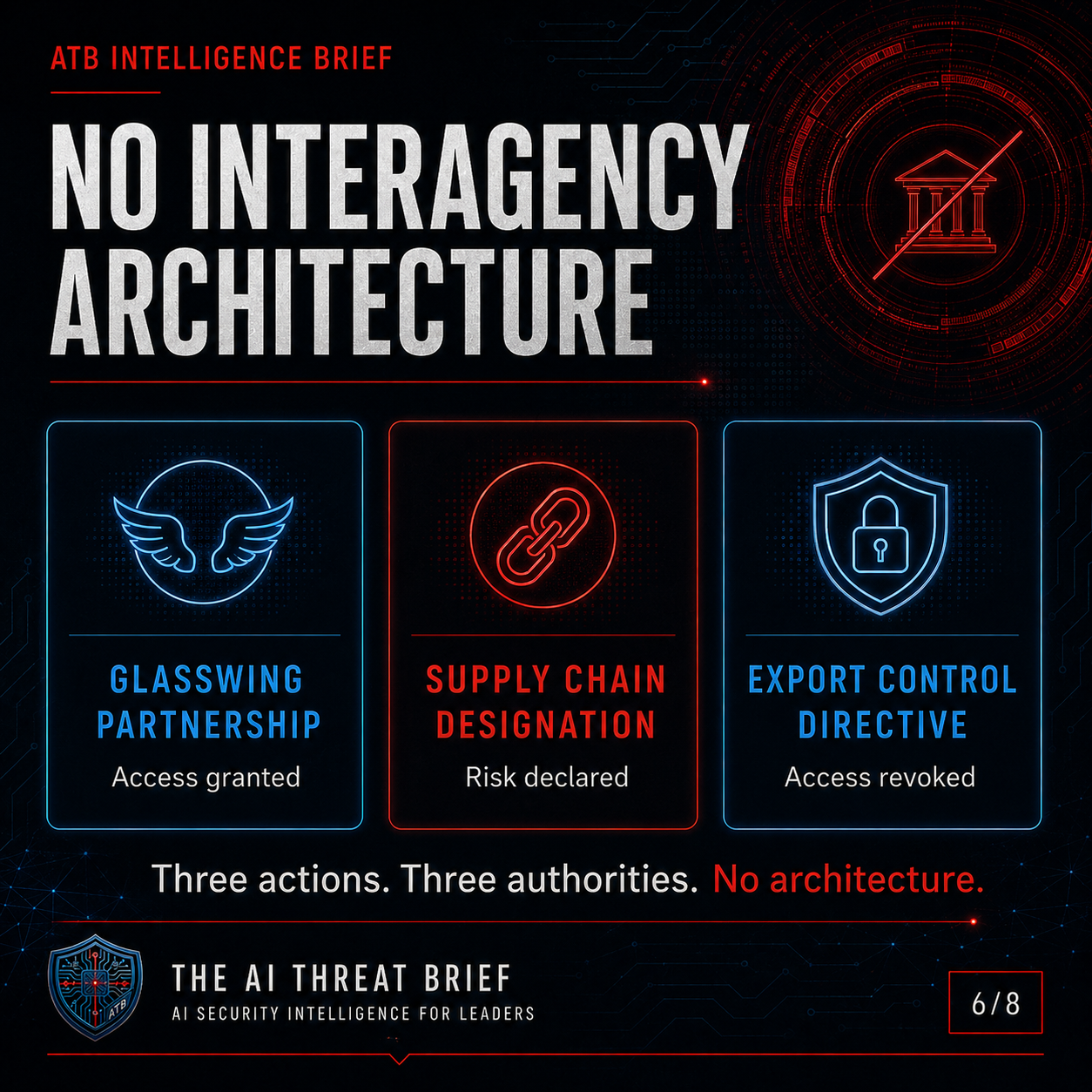
No interagency architecture reconciles the Glasswing partnership, the supply chain designation, and the export control action, all targeting the same company, the same models, the same week. The evidentiary standard that triggered a global commercial shutdown: asking a model to read a codebase and find software flaws. Cybersecurity Dive reports Amazon researchers found the bypass and Andy Jassy warned administration officials. A cybersecurity CEO who reviewed the research told Fortune it was defensive work. The trigger for the directive may not have been an independent government security assessment at all.

Enforcement without architecture is not governance. It is the governance gap this series named in April, now at full scale.

Full analysis at theaithreatbrief.com

♾ The AI Threat Brief | AI Security Intelligence for Leaders

#AIGovernance #AIRisk #CyberSecurity #EnterpriseAI #ExportControls #AIPolicy #NationalSecurity #CISO

View on LinkedIn →

Carousel

ATB Intelligence Brief

Opening Statement

On June 12, at 5:21pm ET, the US government answered the question this series has been tracking since April. The answer arrived as a Commerce Department directive ordering Anthropic to suspend all access to Fable 5 and Mythos 5 by any foreign national, anywhere on the planet. Because Anthropic cannot verify user nationality at scale, both models went dark globally. Every customer. No advance notice. No technical findings disclosed to the company receiving the order.

Press coverage framed it as government intervention in a dangerous AI deployment. That framing is wrong. The directive demonstrates that the US government has no coherent architecture for governing frontier AI capability. When it needed one, it reached for an export control mechanism built for weapons hardware and semiconductor transfers. The instrument it chose tells enterprise security leaders more than the shutdown itself.

Primary Analysis

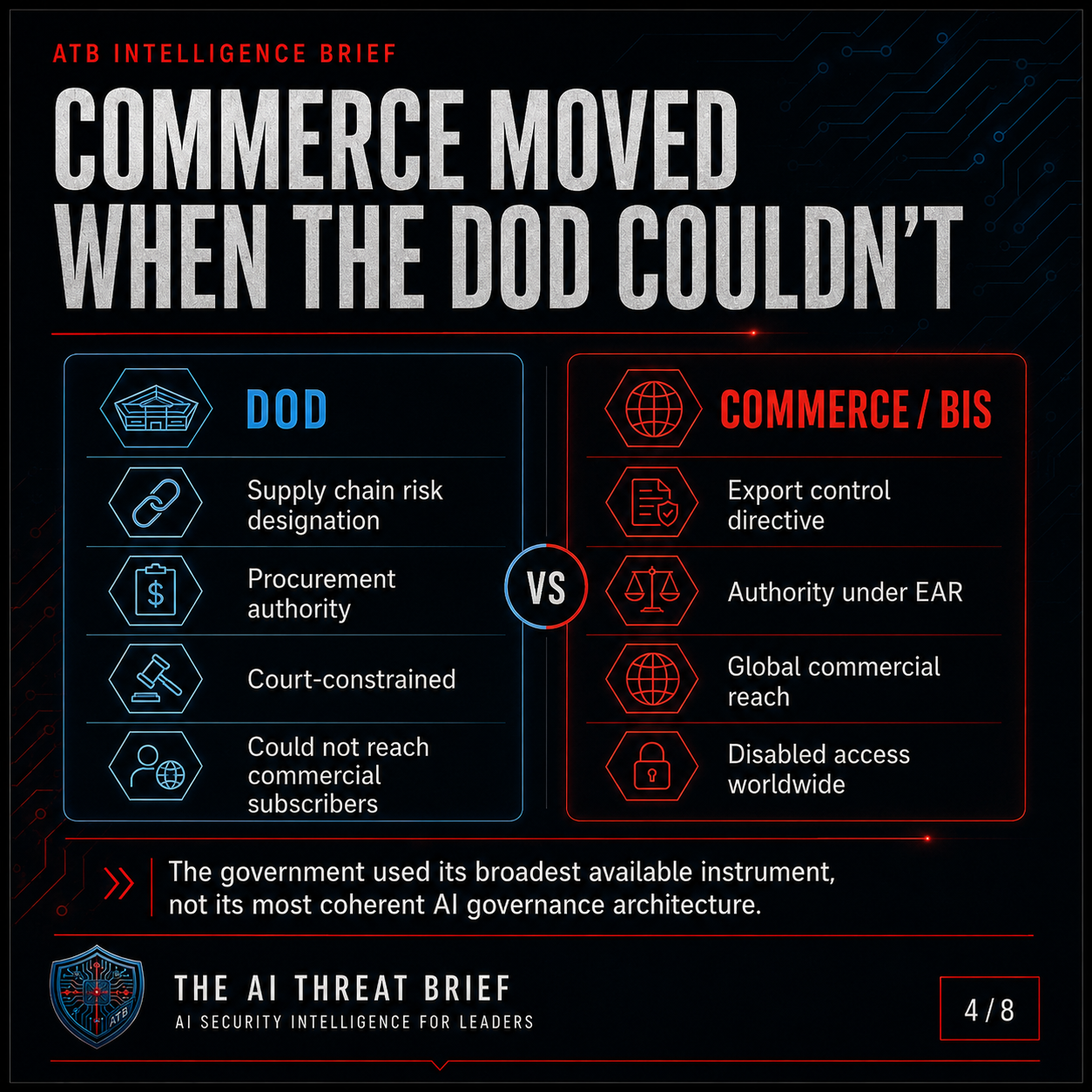
The Department of Defense and the Department of Commerce are not running the same AI governance program. They run separate enforcement programs with different legal authorities, different scopes, and different implied positions on what Anthropic represents.

The DOD designated Anthropic a supply chain risk in March 2026, after contract negotiations collapsed over two AUP exceptions Anthropic refused to waive: mass domestic surveillance and fully autonomous weapons. That designation is a procurement authority. It bars government contractors from using Anthropic's technology in DoD work. It cannot reach a commercial subscriber in Frankfurt or a Glasswing partner in Seoul. A California court issued a preliminary injunction partially blocking enforcement before June arrived.

Commerce's Bureau of Industry and Security operates under different authority. The Export Administration Regulations govern the transfer of dual-use technology to foreign nationals, a framework built for the Commerce Control List: semiconductor equipment, encryption software, weapons-adjacent hardware. The June 12 directive extended it to conversational access to an AI model, triggered by verbal reports of a non-universal jailbreak. The government has not publicly identified the specific statutory basis for that extension.

The government used its broadest available instrument, not its most legally coherent one. Commerce reached for a different pathway when the DOD's authority was court-constrained. The result was global commercial shutdown, a scope the supply chain designation could never have produced.

The jailbreak claim warrants direct scrutiny. Anthropic's statement describes receiving only verbal evidence: a technique consisting of asking the model to read a codebase and identify software flaws. A cybersecurity CEO who reviewed the research told Fortune it was defensive work, not offensive. Cybersecurity Dive reported that Amazon researchers identified the bypass and that CEO Andy Jassy warned administration officials, meaning the trigger may have been an Amazon finding escalated through a political channel, not an independent government security assessment. The evidentiary standard applied here, verbal evidence with no technical specifics and no advance process, is a governance problem regardless of whether the underlying security concern is legitimate.

Evidence Layer

The July 2025 Pentagon contract made Claude the first frontier model approved for classified network use. That relationship collapsed inside eighteen months. By March 3, 2026, the supply chain risk designation arrived, the first ever applied to a US company. Anthropic sued in two federal courts and won partial injunctive relief in California.

On June 1, Anthropic confidentially filed for a US IPO. The filing came four days after the company closed a $65 billion Series H round at a $965 billion post-money valuation, the highest private valuation any AI company has carried. The following day, Trump signed an executive order establishing a voluntary framework for AI developers to provide the government up to 30 days of pre-release access to covered frontier models for cybersecurity review. Eight days later, Fable 5 and Mythos 5 launched. Anthropic reversed a contested hidden safeguard within 48 hours of launch and apologized publicly. Three days after launch, Commerce shut both models down globally.

The same week the US government held Glasswing partnership status with Anthropic, a different arm of that same government issued the directive disabling Mythos 5 for every customer on the planet. Glasswing participants, including international partners who received access just weeks earlier, were not exempted.

Governance and Policy Intersection

No existing AI governance framework anticipated this mechanism. The government's authority derived from the Export Administration Regulations, marking the first application of the Export Control Reform Act to hosted AI model access in US regulatory history. That legal basis has not been tested in court or grounded in public rulemaking. What happened on June 12 was export control enforcement applied to an AI access problem because export controls carried the broadest available reach, not because they were designed for the problem.

There is no interagency AI authority reconciling the DOD's supply chain designation, Commerce's export control action, and the Glasswing partnership structure. These are independent enforcement actions from separate agencies with conflicting implied positions on the same company, the same models, the same week.

Brad Carson of Americans for Responsible Innovation described the action as failing the test of consistency, fairness, and a clear rules-based process. No independent verification infrastructure exists to make government determinations about AI capability credible. The June 12 directive substituted enforcement speed for governance credibility.

The interagency contradiction runs deeper than agencies holding conflicting positions. The Financial Times reported that Anthropic had deployed engineers inside the NSA to guide its use of Mythos for offensive cyber operations, with one source noting the model would be useful for infiltrating networks in adversarial countries. Whether Mythos was in active offensive use at the time of the directive remained unconfirmed. The government deploying Mythos 5 for offensive operations and the government that shut it down as a national security risk are the same government.

Enterprise Implications

A model available at 9am on June 12 was disabled at 5:21pm the same day. No service level agreement covers government-ordered global suspension. Organizations that built workflows, products, or operations on Fable 5 or Mythos 5, Glasswing participants included, had no notice and no recourse. Within 48 hours, more than 76 security practitioners, CISOs, and researchers signed an open letter to Commerce Secretary Lutnick demanding the directive be lifted and calling for a transparent, scientific AI risk assessment process.

The directive applied to foreign nationals whether inside or outside the United States, including Anthropic's own employees. For enterprises with international workforces using frontier AI models in daily operations, this event surfaces access control and continuity questions that existing export compliance frameworks were not built to answer.

The risk category requiring reassessment is third-party AI risk. Government enforcement action against a frontier model provider is now a demonstrated material operational risk for every enterprise downstream. It cannot be addressed through SLA negotiation alone. It requires a controls posture, not a contract clause.

Closing Signal

The Weaponized Access series has been asking who owns the decision when frontier AI capability exceeds what existing governance frameworks were built to contain. On June 12, the government answered. It owns the decision. It will exercise that ownership through whatever legal authority carries the broadest available reach. It may not disclose the technical basis. It will not guarantee advance process. The commercial effect will be global.

Enterprise security leaders should take from that answer something more precise than a shutdown recap. The government demonstrated it can disrupt frontier AI deployment. It has not demonstrated it can govern it. Export control frameworks designed for semiconductors are not AI governance architecture. The legal basis for this specific application of BIS authority has not been tested. The interagency coherence that would make such authority consistent and predictable does not exist.

The difference between disruption capability and governance architecture is where F1-P4 begins.

Intelligence Expanded Content

Full analysis available to ATB subscribers

The expanded brief goes deeper — additional analysis, extended source commentary, and the full governance implications not covered in the public Intelligence Brief. Available with an ATB subscription.

Subscribe for Access →

Source Dossier

Source Dossier — F1-P3

The Government’s Answer

ATB publishes a full source dossier for every Intelligence Brief. Every source used in this analysis is listed below with its tier classification, any editorial disclosure that applies, and a brief note on why this source was included.

Source Tier Definitions: Primary — original reporting, official documents, peer-reviewed research, direct vendor disclosures. Secondary — credible analysis citing primary sources, established trade press with editorial standards.

Primary Sources

1. Anthropic — Statement on the US Government Directive

Published: June 12, 2026 | Tier: Primary

Editorial Disclosure: Anthropic is the company whose models were shut down by the directive. All characterizations of the jailbreak scope, the defense rationale, and the compliance method originate here and are attributed explicitly.

Foundational source for the shutdown architecture: the received directive, the decision to disable globally, Anthropic’s characterization of the jailbreak evidence as verbal-only, and the defense that the same output is available from GPT-5.5 without a bypass.

anthropic.com/news/fable-mythos-access

2. Anthropic — Statement on Comments from Secretary of War Pete Hegseth

Published: February 2026 | Tier: Primary

Editorial Disclosure: Anthropic — same as Source 1.

Documents Anthropic’s AUP red lines: the two explicit exceptions Anthropic refused to waive for the DoD — mass domestic surveillance and fully autonomous weapons — which precipitated the Pentagon contract collapse and subsequent supply chain designation.

anthropic.com/news/statement-comments-secretary-war

3. freefable.org — Open Letter on Transparent AI Cyber Protections

Published: June 14, 2026 | Tier: Primary

The 76+ signatory open letter from security practitioners and CISOs addressed to Commerce Secretary Lutnick and CISA Director Cairncross. Primary source for the practitioner community’s formal rejection of the evidentiary standard used to trigger a global commercial shutdown.

freefable.org

Independent Legal Analysis

4. Volkov Law — When the Government Pulls the Plug

Published: June 14, 2026 | Tier: Secondary

The strongest independent source on BIS authority. Key finding: the specific statutory basis for applying ECRA authority to hosted AI model access was not publicly identified at time of the directive. Confirms the legal extension is untested in court.

blog.volkovlaw.com — When the Government Pulls the Plug

5. Latham and Watkins — EO Analysis

Published: June 2026 | Tier: Secondary

Most precise legal analysis of the June 2 executive order. Confirms the voluntary pre-release access framework, the 30-day window, and the August 1 deadline. Establishes the EO timeline relative to the June 12 directive.

lw.com — Latham EO Analysis

6. R Street Institute — The Fable Fiasco

Published: June 2026 | Tier: Secondary

Editorial Disclosure: R Street Institute is a free-market policy organization. Its analysis of the directive is independent but ideologically aligned toward deregulation. Analytical conclusions require that context.

Source for the deemed export provision legal analysis. Confirms ITAR and Know Your Customer frameworks do not apply to this situation, clarifying why BIS was the instrument chosen.

rstreet.org — The Fable Fiasco

7. Council on Foreign Relations — EO Assessment

Published: June 2026 | Tier: Secondary

Confirms the 30-day voluntary pre-release framework and that the June 2 EO followed a pulled May draft. Provides geopolitical framing for the EO in the context of US-China AI competition.

cfr.org — CFR EO Assessment

8. Mayer Brown — DoD Supply Chain Risk Analysis

Published: March 2026 | Tier: Secondary

Authoritative account of the July 2025 Pentagon contract backstory and the FASCSA framework under which the supply chain designation was issued. Establishes the legal architecture the DoD used before Commerce intervened.

mayerbrown.com

9. Pearl Cohen — Anthropic Sues DoD

Published: March 2026 | Tier: Secondary

Documents Anthropic’s dual federal lawsuits against the DoD designation and the AUP red lines that triggered the contract collapse. Establishes the judicial context that constrained DoD enforcement before Commerce acted.

pearlcohen.com — Anthropic Sues DoD

IPO and Valuation Sources

10. TechCrunch — Anthropic Files to Go Public

Published: June 1, 2026 | Tier: Secondary

Primary press source for the June 1 S-1 filing and the $965B Series H post-money valuation. Establishes the IPO timing context that makes the June 12 shutdown analytically significant for institutional investors.

techcrunch.com — Anthropic Files to Go Public

11. TechCrunch — Anthropic Raises $65 Billion

Published: May 28, 2026 | Tier: Secondary

Series H close at $965B post-money. Documents investor list and the pre-IPO bridge confirmation.

techcrunch.com — Anthropic Raises $65 Billion

12. Fortune — Anthropic Confidentially Files IPO

Published: June 1, 2026 | Tier: Secondary

Corroborates the $965B valuation and confirms Anthropic eclipsed OpenAI’s private valuation mark ahead of the filing.

fortune.com — Anthropic Files IPO

NSA Offensive Use Sources

13. Tom’s Hardware — NSA Using Mythos for Offensive Cyber Operations

Published: June 2026 | Tier: Secondary

Financial Times corroboration: confirms 6 Anthropic engineers embedded at NSA, with the source noting Mythos would be useful for infiltrating adversarial networks. Whether the model was in active offensive operations at the time of the directive remained unconfirmed.

tomshardware.com

14. TechCrunch — NSA Readying Mythos for Cyber Operations

Published: June 2026 | Tier: Secondary

Key qualification for ATB’s framing: TechCrunch clarifies it is unclear whether engineers or the Mythos model itself was in active hacking operations. ATB’s characterization uses this qualification as the baseline.

techcrunch.com — NSA Readying Mythos

Amazon / Directive Trigger

15. Cybersecurity Dive — Export Ban Trigger and Practitioner Response

Published: June 2026 | Tier: Secondary

Editorial Disclosure: Amazon is a Glasswing participant and major Anthropic investor. The evidentiary chain from Amazon researchers to the directive ran through a party with direct commercial stakes in the model access policies governing both companies. This conflict of interest is material to how this source is used in the post.

Documents the Amazon/Jassy trigger: researchers identified a bypass, Jassy warned administration officials. Also the 76+ signatory count for the freefable.org letter.

cybersecuritydive.com — Export Ban Trigger

16. Infosecurity Magazine — Cyber Experts Urge US to Lift Ban

Published: June 2026 | Tier: Secondary

Documents the initial 54+ signatory count and the open letter addressees (Lutnick and Cairncross). Cross-reference with freefable.org for the full signatory record.

infosecurity-magazine.com — Cyber Experts Urge US

Executive Order Sources

17. CNBC — Trump Signs AI Executive Order

Published: June 2, 2026 | Tier: Secondary

Confirms the EO’s existence and the voluntary pre-release benchmark framework. Establishes the one-day gap between the IPO filing and the EO that positioned the government as Anthropic’s trusted partner.

cnbc.com — Trump Signs AI Executive Order

18. Federal News Network — AI EO Cybersecurity Directives

Published: June 2026 | Tier: Secondary

30-day pre-release framework detail. Confirms the EO bars mandatory requirements, making the framework voluntary and the June 12 directive a separate enforcement instrument with its own legal basis.

federalnewsnetwork.com — AI EO Cybersecurity

Press Corroboration

19. Fortune — Covert Limits Walk Back (June 10, 2026)

Tier: Secondary — Coverage of Anthropic’s acknowledgment that Fable 5 had undisclosed capability limits that were reversed within 48 hours of launch. | fortune.com

20. Fortune — “It’s Not a Jailbreak” (June 13, 2026)

Tier: Secondary — Unnamed cybersecurity CEO characterizes the Amazon research as defensive work, not offensive. ATB uses this characterization with attribution to the unnamed source. | fortune.com

21. CNBC — Shutdown Story (June 12, 2026)

Tier: Secondary — Real-time coverage of the global shutdown. Documents the 5:21pm ET timestamp and the scope of the disablement. | cnbc.com

22. CNBC — DoD Supply Chain Risk Designation (March 5, 2026)

Tier: Secondary — First press coverage of the supply chain designation and the Iran connection cited by the Pentagon. | cnbc.com

23. Nextgov/FCW — Brad Carson / ARI Quote

Tier: Secondary

Editorial Disclosure: Americans for Responsible Innovation is an advocacy organization with a stated policy position on AI governance. Carson’s quote (“failing the test of consistency, fairness, and a clear rules-based process”) is attributed to him and ARI, not presented as neutral analysis.

nextgov.com — Brad Carson Quote

24. ITECS — Commerce vs. DoD Authority

Tier: Secondary — Technical comparison of Commerce and DoD enforcement authority. Confirms the separate legal frameworks and why Commerce’s reach was broader. | itecsonline.com

ATB Editorial Transparency

ATB publishes a full source dossier for every Intelligence Brief. Sources are tiered, editorial disclosures are applied to affiliated or advocacy-aligned sources, and analytical weight is documented. The Amazon conflict of interest at the directive trigger point is material and is disclosed in Source 15. All legal analysis in this post is grounded in independent legal sources (Sources 4–9) — not in ATB’s own legal interpretation.

ATB Source Dossier | F1-P3 — The Government’s Answer | Weaponized Access Series | theaithreatbrief.com | June 2026
Source Dossier

Intelligence Direct

MORE FROM THE AI THREAT BRIEF

Every brief connects a security threat to the governance gap your organization isn’t watching. Subscribe for practitioner intelligence delivered direct.

Browse All Briefs →Subscribe Free