The AI Threat Brief

Analysis-Led

The Access Philosophy Divide

When private companies assume governance authority over capabilities with national security implications, no existing framework — not NIST AI RMF, not the EU AI Act — establishes what accountability architecture should govern how they make that call.

June 1, 2026

F1-P1

Series:

·

LinkedIn Post

Two private companies made two governance decisions thisspring.

 Nobody authorized them to do it.

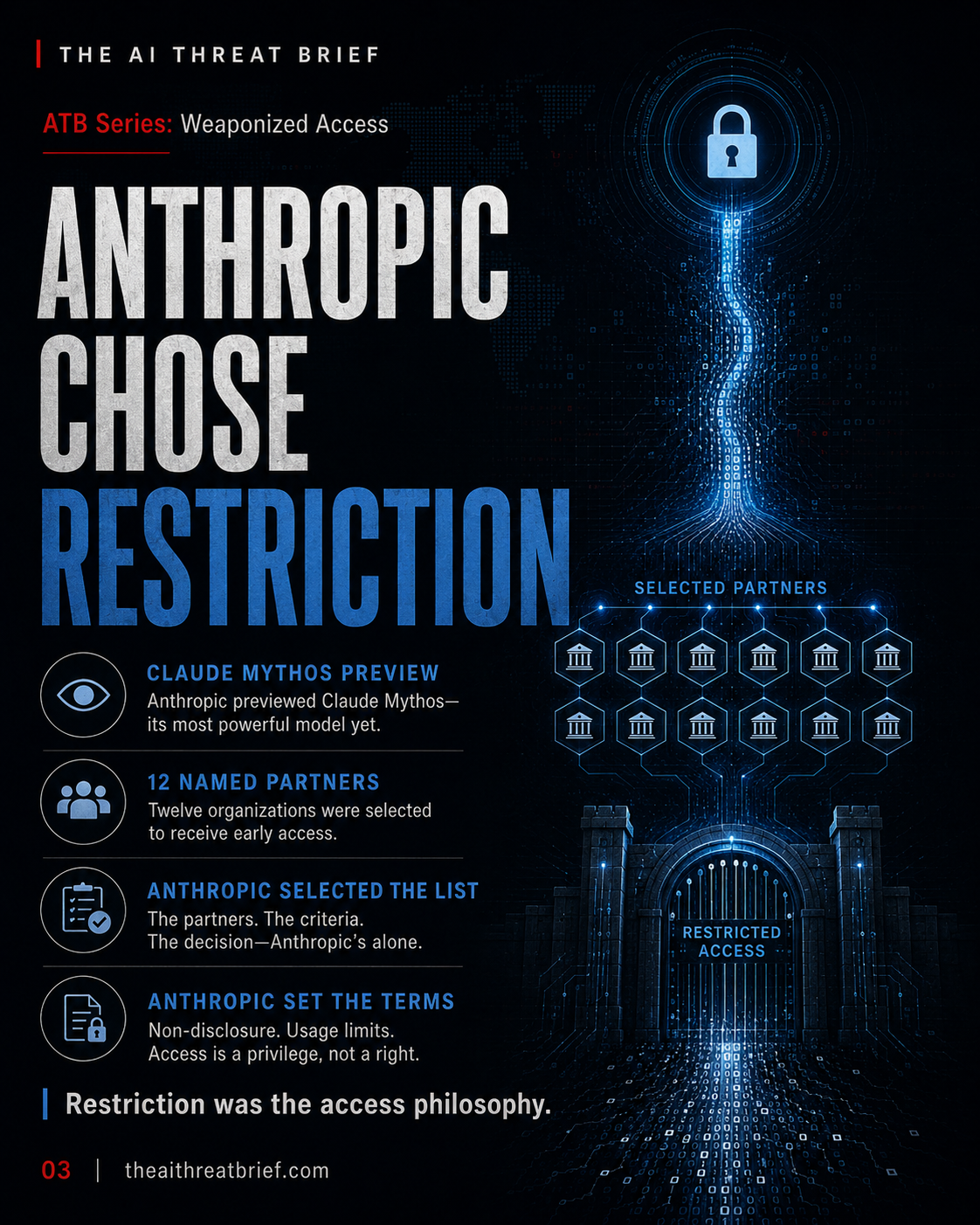
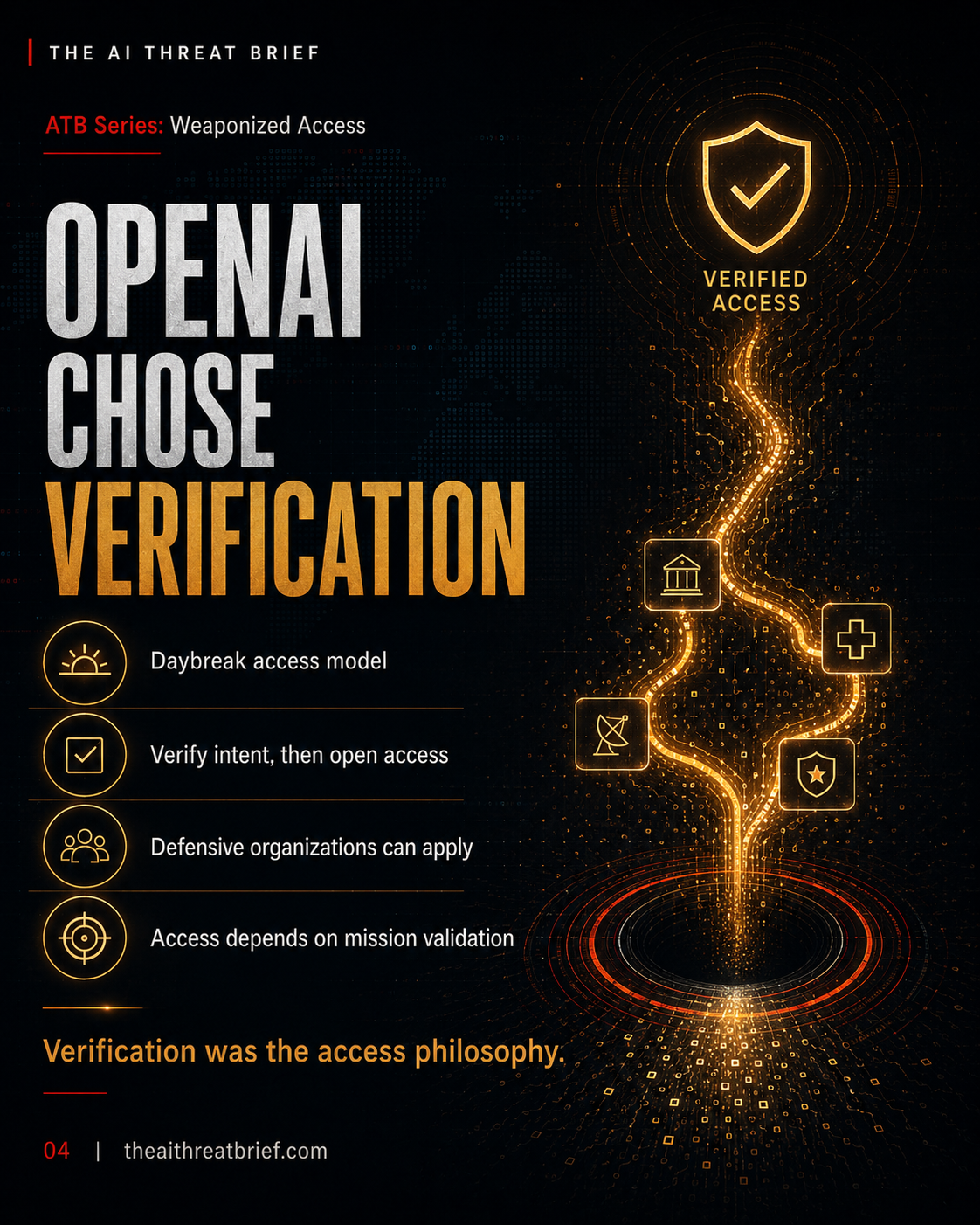
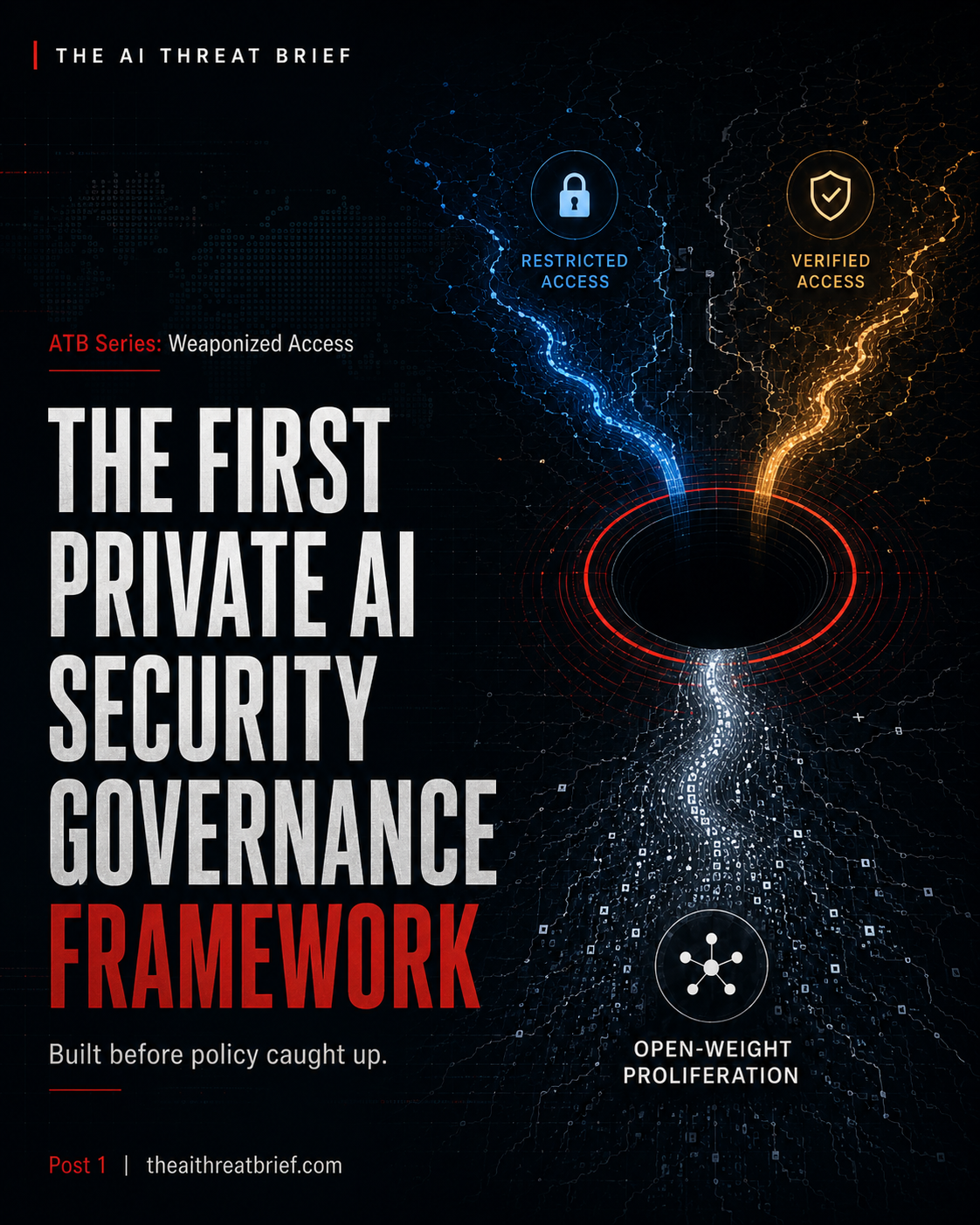
Anthropic restricted access to Claude Mythos Preview whichis currently the most capable AI vulnerability discovery system publiclydocumented. Deployed to 12 named partners. They selected the list. They set theterms. OpenAI answered two weeks later with a different philosophy: verifyintent, open access. Any organization that can document a defensive mission canapply.

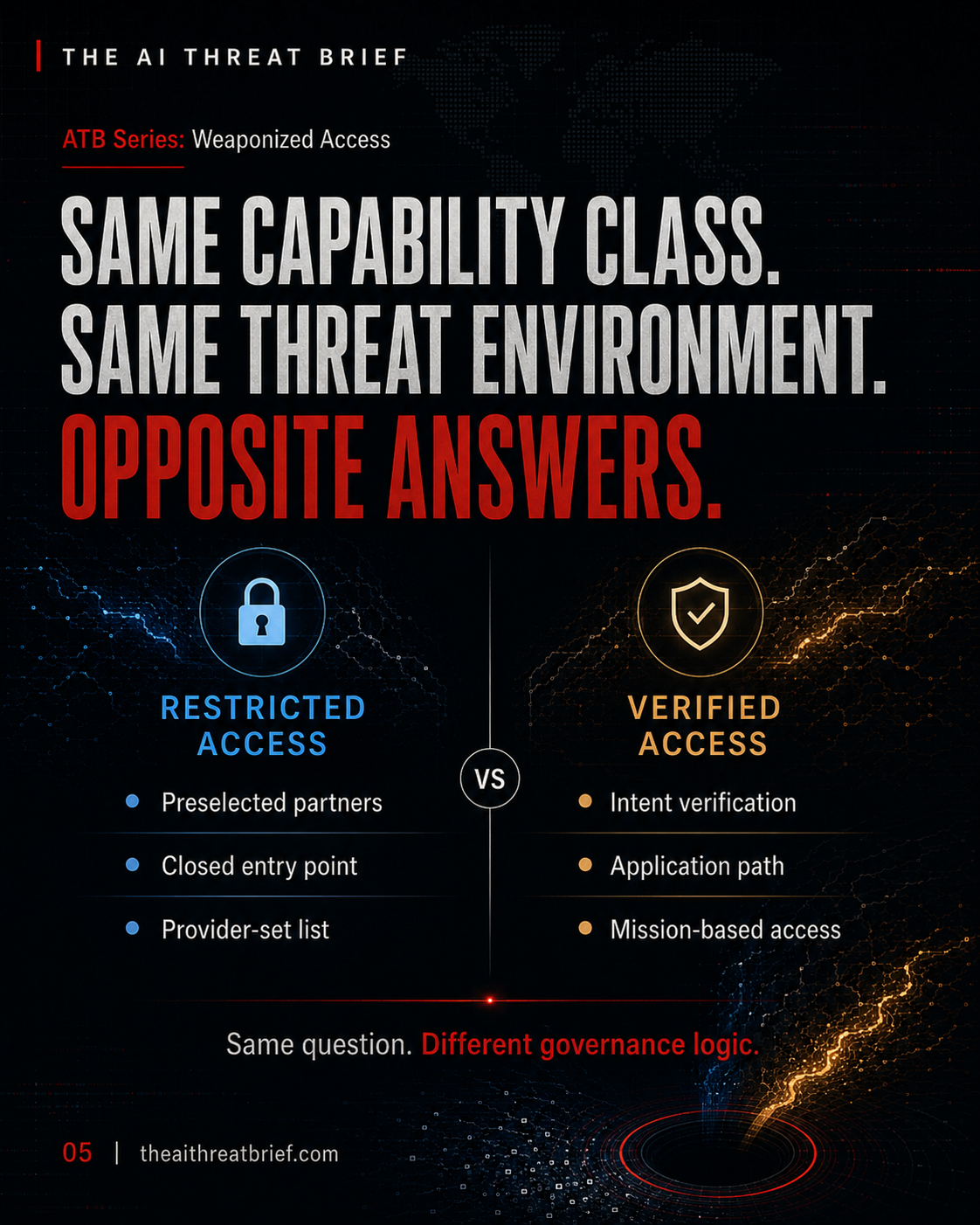
Same capability class. Same threat environment. Oppositeanswers to the same question.

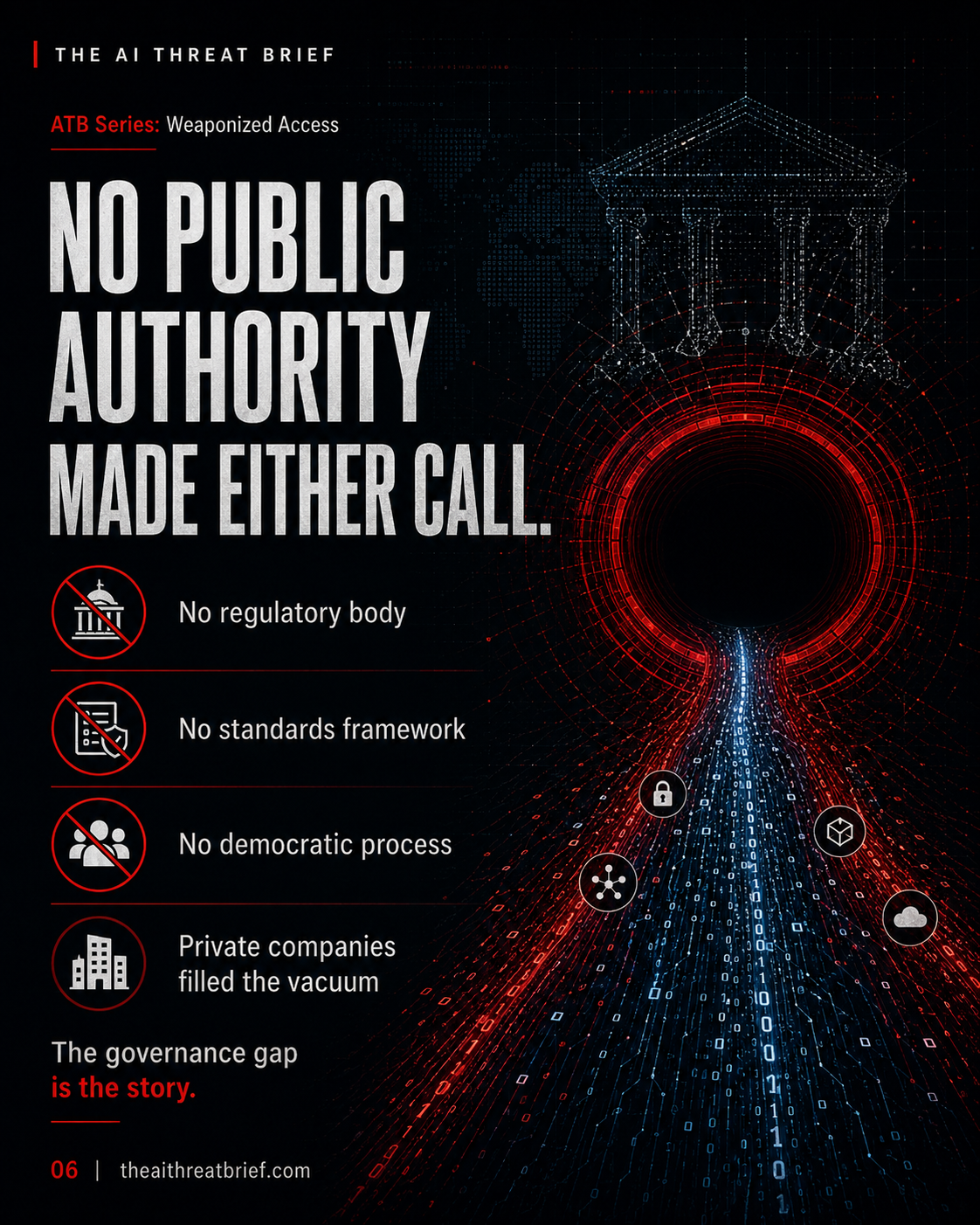
Neither answer came from a regulatory body. No standardsframework required for either access model. No democratic process validatedeither decision.

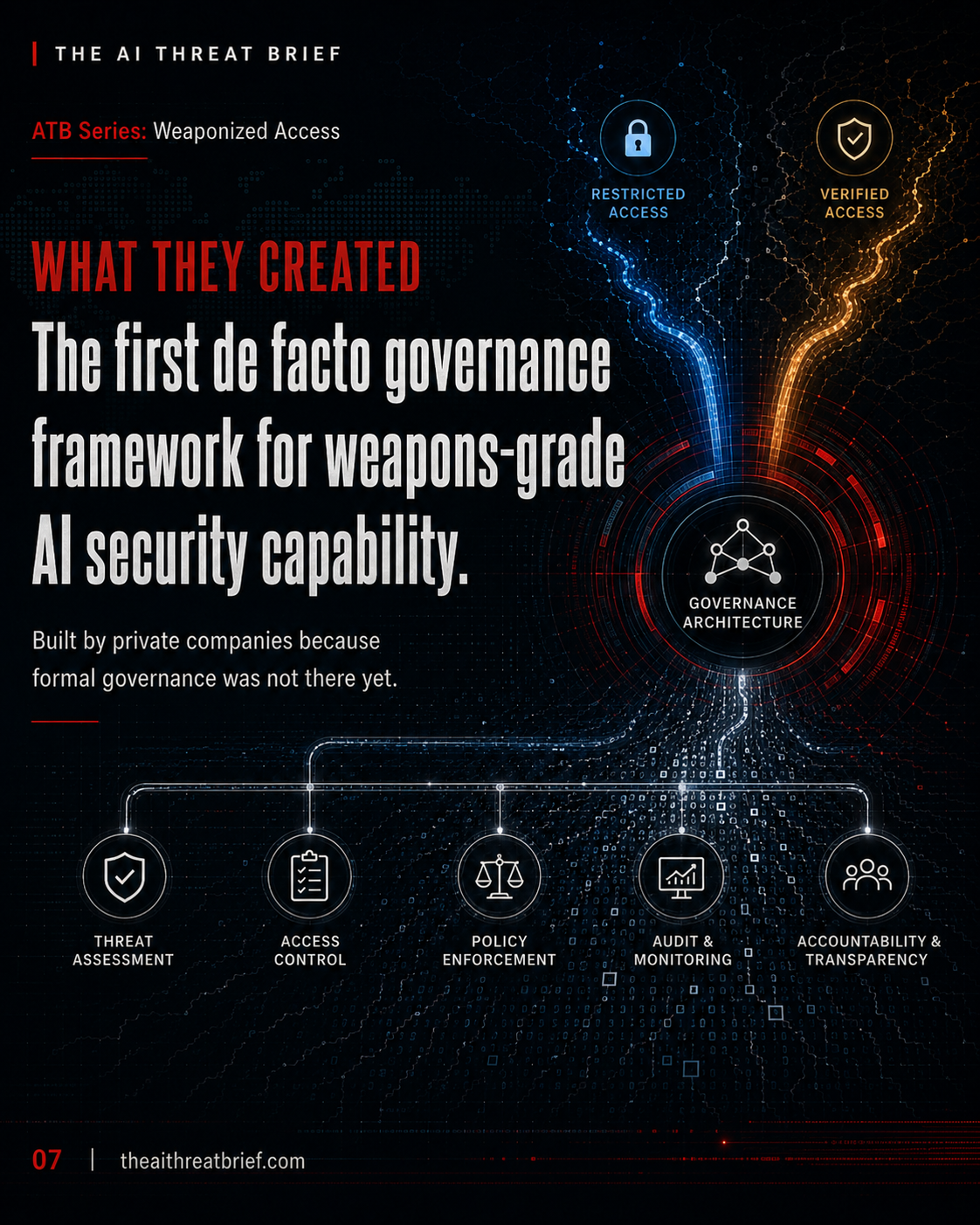
What Anthropic and OpenAI produced is not a product launch.It is the first de facto governance framework for weapons-grade AI securitycapability written by two private companies, for the rest of the world, becauseno government had written it yet. That gap is not a policy failure. It is asequencing problem. Capability development is running faster than governancearchitecture can be built.

The question worth tracking is not which access model issmarter. It is who had the authority to make this call and what happens whenthe answer is nobody, and they made it anyway.

This is Post 1 of Weaponized Access: a new ATB series examining who actually controls the decision-making architecture behind AI security capability. If this is the kind of analysis you need, follow now. The governance gap only gets more consequential from here.

♾ The AI Threat Brief | AISecurity Intelligence for Leaders


#AISecurity #AIGovernance#CyberSecurity #CISO #AIRisk #ThreatIntelligence #ZeroTrust

Full Intelligence Brief and source dossier at theaithreatbrief.com.

View on LinkedIn →

Carousel

ATB Intelligence Brief

Two private companies made two governance decisions in April and May of 2026. Nobody authorized them to do it. Nobody stopped them either.

When Anthropic announced Project Glasswing on April 7, it restricted access to Claude Mythos Preview to 12 named partners; a list of organizations the company selected, vetted, and approved without external mandate. When OpenAI launched Daybreak on May 11, it answered with a different philosophy: verification-gated access, open to any organization willing to submit documentation proving defensive intent. Same capability class. Same threat environment. Opposite answers to the same question.

Neither answer came from a regulatory body. No international standard required either access model. No democratic process validated either decision. What Anthropic and OpenAI produced was not a product launch. It was the first de facto governance framework for weapons-grade AI security capability that's written by two private companies, for the rest of the world, because no one else had written it yet.

That is the frame this series is built around. Not which model is more capable. Not which access philosophy is more commercially viable. The question ATB is tracking is harder than both of those: when private companies assume governance authority over capabilities with national security implications, what mechanisms exist to evaluate whether they made the right call?

The CETaS analysis of Mythos-class capability treats this as an open question, not a settled one. Independent researchers looking at frontier AI security capability do not arrive at clean consensus on where the access restriction line should be drawn. Anthropic drew it at 12 partners. OpenAI drew it at anyone who can fill out a form. Neither company demonstrated that it had the analytical framework to know where the line belonged — only that it had the market position to enforce wherever it decided to put it.

The Governance Gap Nobody Is Naming

The NIST AI Risk Management Framework addresses AI system risk at the organizational level. The EU AI Act establishes risk categories. Neither framework contemplates a scenario where a frontier AI lab unilaterally restricts access to a capability class with direct implications for national vulnerability infrastructure — and does so before any regulatory body has established a governing standard for that decision.

That gap is not a policy failure in the conventional sense. It is a sequencing problem. Capability development at frontier labs is running faster than governance architecture can be built. Glasswing and Daybreak did not expose a hole in existing regulation. They exposed that existing regulation was never designed for this category of decision.

The governance question is not whether Anthropic or OpenAI made the wrong call. It is whether private companies should be making this call at all — and if they must, what accountability architecture should govern how they make it.

Enterprise security leaders are operating in the gap between those two answers right now. Whether your organization is on the Glasswing partner list or not, the access philosophy divide shapes your threat environment. The actors who want to exploit AI-discovered vulnerabilities are not waiting for governance clarity. The defenders building detection capability around those same vulnerability classes are operating with unequal access to the tools that find them.

That asymmetry is the series. The verdict on whether either company made the right call comes later.

Intelligence Expanded Content

Full analysis available to ATB subscribers

The expanded brief goes deeper — additional analysis, extended source commentary, and the full governance implications not covered in the public Intelligence Brief. Available with an ATB subscription.

Subscribe for Access →

Source Dossier

Source Dossier — F1-P1

The Access Philosophy Divide

ATB publishes a full source dossier for every Intelligence Brief. Every source used in this analysis is listed below with its tier classification, any editorial disclosure that applies, and a brief note on why this source was included. This is ATB’s editorial transparency standard.

Source Tier Definitions: Primary — original reporting, official documents, peer-reviewed research, direct vendor disclosures. Secondary — credible analysis citing primary sources, established trade press with editorial standards.

Primary Sources

1. Anthropic — Project Glasswing Announcement

Published: April 7, 2026 | Tier: Primary

Editorial Disclosure: Anthropic developed Mythos Preview and operates Project Glasswing — the direct subject of this post. All Glasswing architectural claims originate here and are attributed explicitly.

The foundational source for Glasswing’s architecture, partner selection rationale, and access philosophy. The 12 named partners, the vulnerability discovery claims, and the restriction model all originate in this document.

anthropic.com/news/project-glasswing

2. Anthropic — Project Glasswing: An Initial Update

Published: May 22, 2026 | Tier: Primary

Editorial Disclosure: Anthropic — same as Source 1.

The primary quantitative record for Glasswing’s 30-day partner findings: more than 10,000 vulnerabilities identified, fewer than 1% patched. The patch gap is the analytical core of this series.

anthropic.com/research/glasswing-initial-update

3. OpenAI — Project Daybreak Announcement

Published: May 11, 2026 | Tier: Primary

Editorial Disclosure: OpenAI developed GPT-5.5 Cyber and operates Project Daybreak — the comparison subject of this post. All Daybreak architectural claims originate here and are attributed explicitly.

The foundational source for Daybreak’s verification-gated access philosophy. The structural contrast with Glasswing’s restriction model is the analytical frame this post establishes.

openai.com/index/project-daybreak

4. Bloomberg — Day-One Glasswing Breach

Published: April 21, 2026 | Tier: Primary

URL parameter guessing gave unauthorized users access to Mythos Preview on the day Glasswing launched. Primary source for the argument that access restriction as a security mechanism was tested immediately and found imperfect.

bloomberg.com/news/articles/2026-04-21/anthropic-glasswing-breach

Secondary Sources

5. CETaS / The Alan Turing Institute — Claude Mythos: What Does Anthropic’s New Model Mean for the Future of Cybersecurity?

Published: April 2026 | Tier: Secondary

The authoritative independent institutional voice on Glasswing’s governance implications. ATB’s primary independent framing anchor for this series: “The Glasswing model — access determined by a single lab’s partner agreements — is unlikely to be the final answer.”

cetas.turing.ac.uk/publications/claude-mythos-future-cybersecurity

6. Wavespeed AI — Glasswing Deep Analysis

Published: April–May 2026 | Tier: Secondary

Independent technical analysis of the 90-day public commitment mechanics and CVE-2026-4747 details. Provides operational depth on the FreeBSD vulnerability that is Glasswing’s primary capability showcase.

wavespeed.ai/glasswing-deep-analysis

7. Picus Security — The Glasswing Paradox

Published: April–May 2026 | Tier: Secondary

Practitioner-level analysis raising the IPO timing concern and the calendar-speed versus machine-speed governance problem. Represents the credentialed security practitioner community’s early reaction to Glasswing’s access model.

picussecurity.com/resource/blog/glasswing-paradox

ATB Editorial Transparency

ATB publishes a full source dossier for every Intelligence Brief. Sources are tiered, editorial disclosures are applied to affiliated sources, and the analytical weight given to each source is documented. The corporate sources provide the facts. The independent sources provide the analytical frame.

ATB Source Dossier | F1-P1 — The Access Philosophy Divide | Weaponized Access Series | theaithreatbrief.com | June 2026
Source Dossier

Intelligence Direct

MORE FROM THE AI THREAT BRIEF

Every brief connects a security threat to the governance gap your organization isn’t watching. Subscribe for practitioner intelligence delivered direct.

Browse All Briefs →Subscribe Free